

A RACI Matrix, otherwise known as a RACI Chart or RACI model, identifies the essential roles and responsibilities of users regarding the major project tasks. RACI Matrix serves as a visual representation of each person’s functional responsibility on a project team. Making these charts is also a good approach to get some practice managing workloads and identifying decision-makers.
Table of Contents
RACI Matrix Roles and Responsibilities
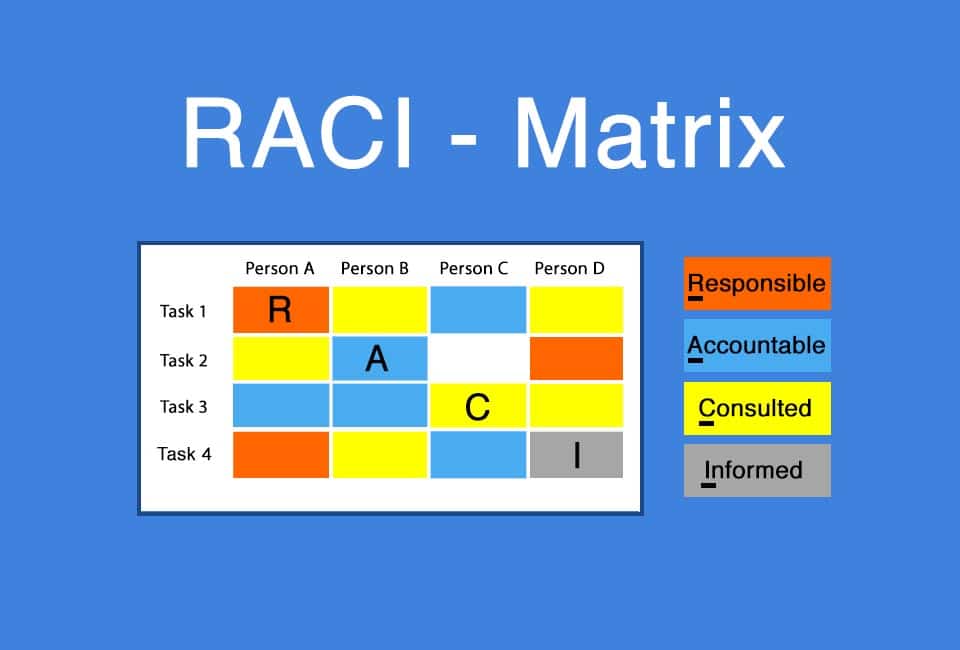
The four roles that stakeholders might play in any project include the following:
- Responsible
- Accountable
- Consulted
- Informed
Responsible
This team member is in charge of completing the task. Every task necessitates the participation of at least one or more responsible parties.
Accountable
The accountable person in the RACI equation delegated and reviewed the project’s work. Their job is to make sure the responsible person or team of the projects understands the project’s requirements. They also take care of the timeline of the projects. Only one person should be held accountable for each assignment. The project team’s responsible parties are frequently in positions of leadership or management.
Consulted
Individuals who have been consulted include subject matter experts or those whose advice is sought before the job is signed off. These active participants are kept in the loop to provide timely feedback.
Informed
The informed portion of the RACI Chart includes people who may need to be updated on the project or the progress of executable tasks. These individuals are not directly involved in the task of decision-making.
Understanding the RACI Model’s Responsible vs. Accountable
The term “responsible” refers to the person (or people) in charge of accomplishing the assignment. A full team can be in charge of completing a single assignment.
Accountable is a result-oriented term that refers to a single individual who reports the task, whether through status updates or delivery. Being accountable means you must take responsibility for the deliverable and/or sign off on it, as well as deal with the consequences if it falls short of expectations.
A single individual can be responsible and accountable for a task in the roles and responsibilities matrix, but not everyone responsible for a task can be held accountable.
How to Create a RACI Matrix?
Step 1: Identify the team members
Identification of team members, including project managers, executive sponsors, product managers, software developers, and business analysts, is mandatory.
Step 2: Determine the project’s significant steps
Website designing, testing, and client approval are examples of the major milestone of the projects like establishing a website. So, the finding of major milestones is required to create a RACI chart.
Step 3: Make a matrix with a column for each task/milestone and a row for each team member.
A RACI chart can be readily created using Microsoft Excel or another software application.
Step 4: Designate the role of each individual for each task, and fill in each box with the corresponding R, A, C, and I.
The project manager would be responsible for gaining the customer’s consent, the executive sponsor would be accountable, and the developer would need to be informed of the conclusion for the client approval milestone in the aforementioned website development example.
Step 5: The project team will discuss, assess, and give their approval
To return to the scenario, it’s feasible that the executive sponsor wishes to be the person who meets with the clients to obtain their permission; thus, they’d be in charge of this duty.
Step 6: Provide everyone with a copy. The file can simply be sent to everyone by the user.
After the approval from the project team, a copy of the final RACI chart should be provided to everyone via mail.
How to Create a Roles and Responsibilities Matrix?
Identify tasks
The first step in developing the RACI matrix is to list all of the tasks that are involved in a project. These jobs must be listed on the left side of the RACI chart in the correct execution order.
Identify project roles
The next step is to list all of the stakeholders at the top of the RACI Chart. This is a list of people who will play various roles in the project’s execution.
Define Key Responsibility Roles in RACI Model
After the tasks and stakeholders have been identified, the decision has to be taken for the next charge holder and further role in the matrix. The RACI chart has to be followed by the series, who is responsible, accountable, consulted, and informed to do this.
Ensure stakeholders are onboard
While creating a RACI matrix should be straightforward, ensuring that everyone is on board is equally vital. People must understand and agree on their RACI matrix roles if they are assigned responsibilities, held accountable, or need to be advised or informed. When individuals aren’t on board or aren’t committed to their roles, it can be difficult to ensure project success or the effective execution of a business process. This is also the time to address any ambiguities or potential disputes to ensure everyone is on board.
Finalize the matrix
After consulting with stakeholders, elements of the RACI chart are restructured. Users can finish the matrix once all stakeholders have been engaged and any potential disputes or misunderstandings have been handled, regardless of whether the matrix remains the same or changes.
Pitfalls and how to avoid them
Getting too granular
This isn’t the project’s blueprint. The obligations and tasks should not be broken down into daily or even weekly activities. It’s time to circulate the project plan if there’s any confusion or requests for further information on the RACI.
Using the same matrix for every project
The RACI chart template can be reused for uniformity, and the PMO is usually in charge of maintaining it. However, each project will have different levels of complexity and milestones, which the chart should reflect.
Lack of consistency
The “accountable” individual in the matrix should be the decision-maker for each task/step/activity/milestone they are allocated. Deviating from the established project roles during “real-life” execution will cause distrust and uncertainty, as well as erode the RACI chart’s effectiveness.
Adding too many columns
Each task/column in the chart should need making a potential decision. As a result, administrative tasks such as team meetings are not included.
Mixing up who is responsible for who is accountable
The individual who is “responsible” for a task should not also be “accountable” for it. It’s uncommon for the person in charge of a task (responsible) to also have the authority to approve work or make decisions (accountable).
How to use RACI Matrix?
A RACI matrix, as a project management tool, assists users in establishing clear expectations for project roles and responsibilities. Because tasks weren’t specified on the front end, they won’t have many employees working on the same task or against one another.
A RACI matrix also encourages team members to take ownership of their work, as well as defer to others when necessary. In other words, users will focus on their team’s capacity to act properly inside a framework they’ve developed rather than on personal judgment and politics.
When to use a RACI Matrix?
RACI charts can be used in nearly any project. It’s useful when jobs use many resources, execute simultaneously, and rely on other tasks. RACI roles and responsibilities matrix is beneficial in the following situations:
- When the decision-making or approval procedure is causing the delay.
- There is disagreement over task ownership and decision-making.
- The project workload appears to be unevenly allocated.
- Users have a lot of turnovers in the team and need to swiftly onboard someone to a new position.
Best Practices for Using a RACI Matrix in Project Management
The following suggested practices can assist users in making the most of their RACI chart:
- In the RACI matrix, concentrate on project tasks, milestones, and decisions. Team meetings and status reports are examples of generic or administrative tasks to avoid.
- To avoid confusion regarding specifics and due dates, align the tasks in users’ RACI chart with their project plan. (TeamGantt takes care of this for the users by linking their RACI chart to your strategy!).
- RACI definitions can be kept handy because they can be difficult to recall at times!
- In TeamGantt, it has to be made sure that the Responsible team members are assigned to tasks.
What are the Rules of RACI Matrix?
Following a few simple guidelines makes using a RACI chart a lot easier. Examine your RACI chart once it’s finished to ensure it fits the following criteria:
- At least one person is responsible for each task.
- Each task has one (and only one!) accountable party, allowing for straightforward decision-making.
- No one on the team is overburdened with responsibilities.
- Each task assigns a position to each team member. (It’s not uncommon for some people to be well-versed in almost every task.)
Pros and Cons of using RACI Matrix
Pros
RACI matrix can provide structure and clarity for projects
The RACI matrix can help users structure their projects properly. It can help with task mapping, stakeholder identification, and role assignment clarity.
Helps identify roles and responsibilities
The RACI Chart can aid in the clarification of roles, responsibilities, accountability, and project execution.
Helps improve accountability
When duties aren’t clearly defined, there can be ambiguity and questions about the person’s dedication. Placing responsibilities in a clearly defined box and ensuring that someone is accountable for deliverables can assist in making things more visible and allow for the assignment of blame in the event of late delivery.
Depending on the situation, the appropriate people can be consulted.
A RACI matrix can help determine if there are too many Rs or Cs, ensuring that no one is over-consulted or assigned additional duties. By balancing responsibilities and who is consulted, the proper persons can be consulted based on necessity, and unnecessary consultation processes that could slow down work can be eliminated.
Projects and processes that are cross-functional or departmental benefit from this.
For cross-functional or departmental projects and processes, the RACI Chart is useful. Its linear structure makes it simple to identify who is responsible for certain activities and deliverables while also allowing for cross-functional and departmental integration.
Cons
RACI does not reflect specific responsibilities and obligations.
A RACI matrix can provide a broad picture of how roles are established for a project, but it may not include precise information on the obligations and responsibilities that each individual is responsible for. The matrix may fall short of covering the responsibilities of certain employees or contractors.
It may be difficult to strike a balance between Rs, As, and Cs.
It can be difficult to strike a balance between obligations, accountability, and who is consulted. There may be occasions when it is necessary to overlap jobs that the matrix does not allow. Due to a lack of resources and the individual’s diverse skill set, small organizations may need to hold one person accountable for many activities. Balancing the Rs, As, and Cs can be difficult, especially when a company’s resources are limited.
Suitable mainly for large projects
A RACI matrix is best suited for large projects. At the same time, it might be difficult to apply to small projects or firms when multitasking and changing hats, which are unavoidable due to a small workforce and limited operating funds.
It might not be suitable for all organizational structures
Because the RACI Chart is a linear matrix, adapting it to all organizational systems might be difficult. Furthermore, due to a lack of experience, some firms may prefer fewer people making decisions, and micromanagement may even be necessary. Startups frequently face this challenge, with decision-making vested in the founder of a small group of individuals. For some organizational architectures, such as a network organizational structure, a RACI matrix may be difficult to apply.
The RACI Matrix may slow down a project or process.
Despite the use of the RACI Chart, ambiguities, inefficiencies in the workload, increased costs, and a slowdown in project or process execution can arise. Users must check that the RACI Chart meets their organization’s structure and requirements before using it.
Conclusion
A well-organized team is crucial to completing a project plan successfully. RACI Matrix serves as a visual representation of each person’s functional responsibility on a project team. Therefore, the RACI chart is a simple tool that makes managing projects easier by creating less confusion and more accountability.
Still, consider that with any PM tool finding the one that works the best for you is key.
Read More
Top 5 Project and Portfolio Management Software in 2022
Top 9 Project Management Software Integrated With Slack to try in 2022
