


Being a SaaS-focused website, we are well-versed in cloud computing since that’s what SaaS is – a cloud-based method for providing software to users.
While cloud computing was expanding rapidly even before the COVID-19 pandemic, the abrupt changes in business operations forced the adoption of cloud computing at an even greater rate. As per PWC, the spending on cloud computing rose by 37% (about $29 billion) during the first quarter of 2020.
Among the recent developments in the cloud computing domain, multicloud (or multi-cloud) is the one that’s garnering a lot of interest. Due to the availability of multiple high-quality cloud service providers, enterprises are quickly moving towards embracing a multicloud strategy by utilizing services from multiple vendors. As per a survey by Gartner, 81% of public cloud users reported using two or more cloud services.
In this article, we’ll talk in-depth about multicloud. This complete guide will touch upon various aspects of multicloud including definitions, benefits, and challenges associated with multicloud.
Table of Contents
In this article
1 – What is multicloud?
2 – What are the benefits of multicloud?
3 – Is multicloud right for your business?
4 – Challenges associated with multicloud
5 – Difference between multicloud and hybrid cloud
6 – Implications of multicloud for SaaS
What is multicloud?
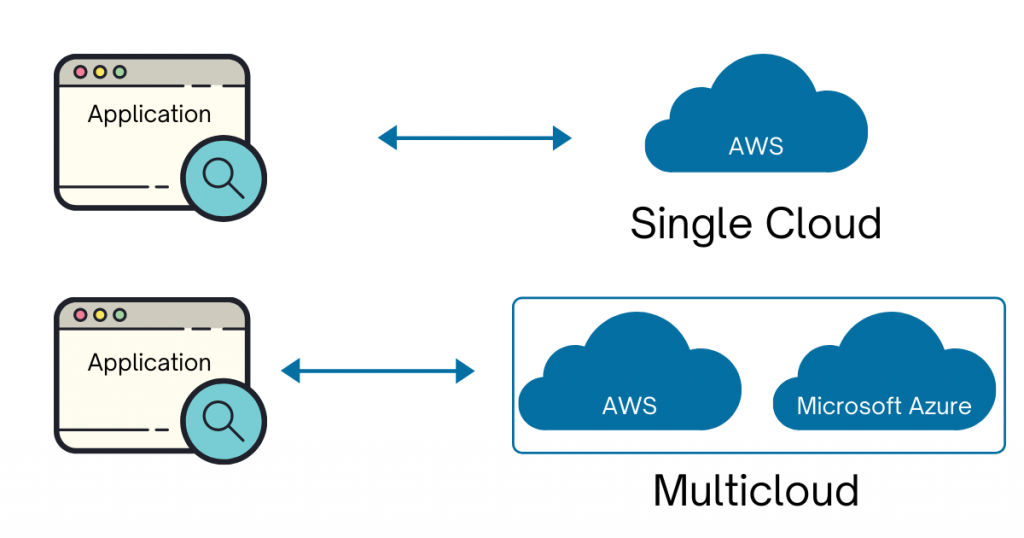
As discussed above, multicloud is a cloud computing strategy where organizations leverage two or more cloud computing platforms to use them as a single unified architecture. This is primarily done when organizations want to avoid the dependency on a single cloud provider and therefore use resources from several providers. Using multicloud allows companies to minimize the risk of downtime and data loss while distributing the computing resources.
Multicloud computing is revolutionizing the way businesses operate, in turn delivering enterprises cost-efficiency, security, flexibility, and agility by leveraging the best components for each use case.
A multicloud environment can be all-public, all-private, or a combination of both.
What are the benefits of multicloud?
The biggest benefit of going with a multicloud approach is that one can choose components from multiple vendors and choose the best fit for their intended purposes. Think of it like à la carte for the cloud.
For example, for an organization that has a dependency on the Windows ecosystem, it would make sense to use some of Microsoft Azure’s services. The same organization can also use Google Cloud for various machine learning or analytics services. This ensures that organizations do not limit themselves because of vendor limitations and instead choose different vendors as per best fit.
Some other key benefits of multicloud include –
Flexibility
Organizations can select different cloud solutions for different aspects of a business. Think of having a proprietary cloud fine-tuned for hosting a proprietary app or an affordable cloud option for archiving records. This kind of flexibility is difficult to achieve with a single cloud.
Suitability
Using multicloud, a company’s IT administrators can line up their business requirements with the best cloud vendor for each individual task. Such task-specific suitability can only be achieved using a multicloud architecture.
Cost efficiency
Multicloud gives organizations the freedom to compare different cloud-hosting providers and get the best available pricing based on their specific IT needs. Competitive pricing is a major pull for multicloud.
Reduced vendor lock-in
When an organization only relies on a single cloud vendor, it can become difficult to move away from them. However, in a multicloud strategy, systems and storage are spread out across multiple vendors. This makes it easier to migrate from one of the vendors without affecting the majority of the infrastructure.
Scalability
Multicloud allows organizations to scale their storage up or down based on current requirements. Usually, multicloud providers work seamlessly together, so businesses can invest in any level of capacity. By being on multicloud, organizations can quickly get critical resources across the business, allowing quick scaling.
Risk mitigation
There may be outages in data centers where cloud vendors host a company’s infrastructure. Such outages can cause significant disruptions for businesses. Therefore, having multiple vendors makes an organization susceptible to malfunctions.
Reduced latency
Using a multicloud strategy gives organizations the ability to choose a cloud provider that has its servers in regions close to the customers’ geographic locations. This helps reduce latency.
Is multicloud right for your business?
Considering the benefits, it’s easy to assume that a multicloud strategy is a no-brainer for any organization. But that’s actually not the case.
Generally, a multicloud deployment should be preferred by organizations that have specific needs or dependencies to satisfy like IoT integration, reliance on specific software, or specific third-party solutions.
Many businesses do not make a deliberate decision to go multicloud. Often, they just think of the benefits and go all-in on a multicloud strategy. If not a conscious strategic decision, multicloud could have multiple potential pitfalls.
Managing multicloud can prove to be complex. To make an informed decision, it’s better to consider the potential disadvantages as well. In the next section, let’s talk about the various challenges that come with multicloud.
Challenges associated with multicloud?
Just like many other things, multicloud has its own set of disadvantages. Let’s discuss a few of them –
Complexity
The higher the number of cloud providers, the more complicated it is to manage them from a task standpoint and a security perspective. A multicloud deployment entails interacting with multiple vendors, processes, and technologies. It can become difficult to have complete visibility into the technology stack.
Security risks
Security is a big concern for organizations across all industries. When using multicloud, organizations need to spend more time and effort on security efforts in order to protect sensitive data from being leaked.
High talent requirement
Cloud professionals are among the most sought-after employees. Recruiting developers, engineers, and security experts for a single cloud provider is already an uphill task for many enterprises. Therefore, finding cloud professionals for multiple cloud providers can prove to be even more difficult.
Data sharing
There can be difficulties in synchronizing and sharing data in multicloud due to differences in provider maturity and API differences.
Difference between multicloud and hybrid cloud
Hybrid cloud is a term that’s often used interchangeably with multicloud. However, both are unique in their own right.
A hybrid cloud can be defined as a subset of multicloud. A hybrid cloud is one that combines on-premise IT infrastructure with off-premise IT infrastructure. So, in a hybrid cloud, there are multiple deployment types with some form of integration between them.
A simple concept to keep in mind is that a hybrid cloud is also a multicloud. However, the inverse is not always true.
Implications of multicloud for SaaS
When implementing a multicloud strategy, organizations need to consider a long list of challenges including SaaS integration.
Organizations need to consider how SaaS integrates into their overall multicloud strategy otherwise it might turn into a complex distributed system with no real governance.
In case you are looking for a SaaS platform for your business then check out SaaSworthy. We help stakeholders choose the right SaaS platform based on detailed product information, unbiased reviews, SW score, and recommendations from active community members.
