

A working enterprise needs to gather around periodically to discuss, organize, share, analyze and distribute knowledge regarding their services to the customers. The objective of this discussion is that knowledge sharing and distribution remain smooth and accessible.
In a nutshell, every organization manages knowledge via FAQs (Frequently Asked Questions), training documents, social skills, and technical resources.
Knowledge management is a systematic technique enabled by every business organization. It offers a platform to all the employees of the organization to store and record knowledge they have acquired so far. This stacking up of knowledge averts any loss of information when an employee leaves the firm.
Table of Contents
What does Knowledge Management involve?
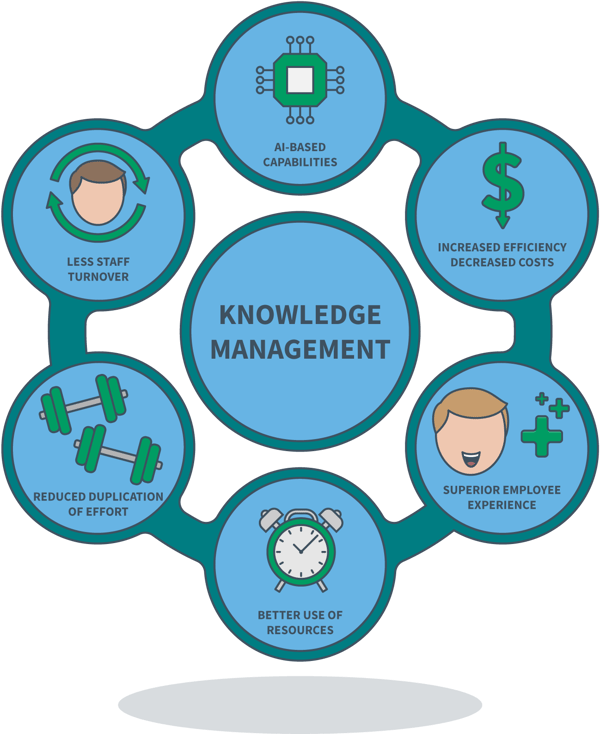
Knowledge management is a technical operation planted to serve knowledge to users in an effortless and accessible manner. This is incorporated through data mining.
A knowledge management plan typically includes a survey and examination of goals, corporate tools, and the current requirements of the organization.
Here is an architecture of knowledge-based system typically used at an enterprise:
- Interface: The topmost panel of the architecture that contributes to user interaction. It is called an ‘interface’ because it lets users convey their queries regarding the knowledge-based system to the organization.
- Interface Engine: This is the panel where the knowledge extraction part begins. This panel interacts with the query base to extrapolate data and gain insights.
- Knowledge Base: The final panel where solutions to old issues are listed as case studies and new rules standing on the edifice of expert knowledge are laid down.
Goals of Knowledge Management
The primary goals of knowledge management include:
- Enhancing the efficiency of the organization
- Distributing knowledge in an accessible form
- Serving the right information in front of the user at the right time
These goals are achieved by performing the following tasks:
- Promotion of new knowledge to implement consistent learning
- Addressing specific topics related to business development via knowledge that is set by a knowledge management system
- Distributing knowledge to a group of people who might find it interesting or useful
- Improving technology, resources, and work procedures in order to provide knowledge easily
So far, we have been emphasizing knowledge and how to manage it effectively. But before we jump into details, let us figure out what knowledge is individual.
Well, to begin with, knowledge is a set of information that an individual has experienced and acquired over time. When an employee or an organization comprehends information by applying resources and everyday experience, they gain ‘knowledge.’
Knowledge can graphically be represented by a triangle called the knowledge triangle. This triangle contains data as the base, information as the intermediate part, and knowledge as the outcome.
- Data: Data are raw facts and figures that hold no relevancy or meaning. They are just random lists of serial numbers or names on a spreadsheet.
- Information: Information is processed data. Any data that has been contextualized, organized, and worked with is called information. Information is stored within documents.
- Knowledge: Knowledge is the understanding of information through skills and experience.
Now that we know what knowledge is, let us shift our focus back to knowledge management (KM). After years of regressive study and rigorous research, a list of key components that make up a knowledge management project (KM). There are generally four components that make up the knowledge management program, and they are:
- Content and IT
- People
- Strategy
- Process
We will discuss all these components thoroughly in the next few sections.
- Content and IT
Content under the knowledge management (KM) arena means any piece of documented knowledge. It involves stuff that is reusable and quickly accessible. It can be templates, project documentation, tutorial video clips, etc.
Content is always riveted beside IT because IT enables people to draw up content. Without IT, people will indeed continue to draw and design content; however, those content pieces would neither be reusable nor accessible. This is because IT extends the platform to individuals where they can easily store and share information, thus enabling knowledge management programs.
- People
The golden paradigm has been quite famous for bringing about measures to put up with revolutionary changes in the organization since the early 90s. The golden triangle consisted of people, processes, and technology.
The theory of the golden paradigm is simple: You overly focus on a single factor, you fail your initiative. Additionally, the order makes a significant difference here, and you need to approach this paradigm in order. First, you need to search for the right people; this means narrowing down the people who might serve the purpose of your initiative, and then you move forward to process and technology.
A knowledge management program requires two types of people:
- Stakeholders that guide you on your initiative. While choosing stakeholders, APQC suggests looking in departments like the Process department, HR, and IT.
- Leaders that extend sponsorships and provide insights into intricating organizational strategies. Sponsoring leaders are often big business owners who are engaged with the program because they can gain something massive from it.
Plus, organizations gather a KM (Knowledge Management) core team to look after the ongoing KM procedures. Thus we see that there are a bunch of people engaged in knowledge management (KM) at every level in order to cultivate knowledge at different points of the business.
- Strategy
Every program demands a strategy to work upon, and an absence of it can indicate risk factors in a business. A skilled team, fully functioning resources, and highly technical systems will be of no use if your organization has no particular strategy to work at. Therefore, in order to avert any circumstances of running a strategy-less business, choose a business study case that aligns fairly well with your enterprise’s knowledge requirements.
The business study case you choose should involve the following points:
- Revenues the KM (Knowledge Management) brought
- How will this KM (Knowledge Management) solve issues
- The resources, approaches, tools, and people this knowledge management (KM) used
- And finally, a preset budget
- Process
Organizations with effective knowledge management have knowledge floating around like streams; whenever you need it, you just pour some for yourself.
But what goes beneath the surface is an intricate chain of processes that only the knowledge management team knows of. However, the process is abstracted to end-users as they need to know nothing about the intricacies of how the knowledge originates. All they need is knowledge and a platform to access it easily.
So, according to organizational standards, there is a seven-step cycle about how knowledge is distributed within an organization. These seven steps include:
- Create
- Identify
- Collect
- Review
- Share
- Access
- Use
- Create: Creation of new knowledge. This takes place every hour and across all business departments.
- Identify: Identify knowledge that might be useful in the future.
- Collect: Collecting the knowledge that is critical and can be shared later.
- Review: Reviewing the knowledge that has been collected for its meaning, relevance, precision, and accuracy.
- Share: Sharing the reviewed knowledge via documents, posts, and other collaborative activities.
- Access: Accessing knowledge through verified mechanisms like push and pull.
- Use: Using the accessed knowledge for problem-solving and decision-making.
Knowledge management is brought into the application by the following tools:
- Training programs
- Forums or community features
- Frequently Asked Questions (FAQs)
- Webinars
- Case studies etc.
Challenges to Knowledge Management

- Lack of motivation: Knowledge managers often find it challenging to motivate employees into sharing their knowledge at a common workspace platform.
- Updating information: Keeping information stored in the knowledge workspace is a big challenge as it changes every hour. Keeping up with the changes of information is necessary and difficult at the same time.
- Security threats: There will always be a security threat threading around your knowledge if they are stored using technology. Technical platforms often fall prey to cracking and data stealing.
Conclusion
I hope we have been successful in our attempt to simplify Knowledge Management and also explain the various challenges involved. To read more about various Software across verticals, explore SaaSworthy right away.
