

Point-of-sale (POS) systems have evolved into more than just cash registers. Today, they power both in-store and online retail operations, giving businesses unified control over sales, payments, inventory, and customer data. But when it comes to choosing a POS solution, pricing clarity is often a challenge.
In this guide, we break down Shopify POS pricing in 2026, its features, total cost of ownership, SaaSworthy insights, and what real retailers on Reddit are saying, so you know exactly what you’re paying for. But before you dive in, have a look at our shortlist of top POS software:
Table of Contents
The State of POS in 2026
The global POS software market is projected to cross $30 billion by 2026, driven by hybrid commerce models where retailers need to sell across physical stores, pop-ups, and online channels seamlessly.
Traditional POS systems (Clover, Lightspeed) still dominate physical retail, but platforms like Shopify have surged by catering to omnichannel-first sellers. The value isn’t just in ringing up sales—it’s in syncing inventory, orders, payments, and customer insights across every channel.
SaaSworthy Insight: In 2026, the most competitive POS systems are not standalone but ecosystem-driven. Shopify’s advantage lies in being an ecommerce-first platform with POS embedded, rather than a POS vendor adding ecommerce as an afterthought.
How Much Does a POS System Cost in 2026?
On average, POS systems cost anywhere between $0 and $2,000 upfront, plus recurring fees for software and payment processing. The final cost depends on:
-
Software subscription tier
-
POS hardware setup (terminals, card readers, receipt printers, scanners)
-
Transaction fees on sales
-
Add-ons and integrations
Retailers also need to account for training, migration, and support costs, which can increase total ownership expenses.
Shopify POS Pricing Breakdown
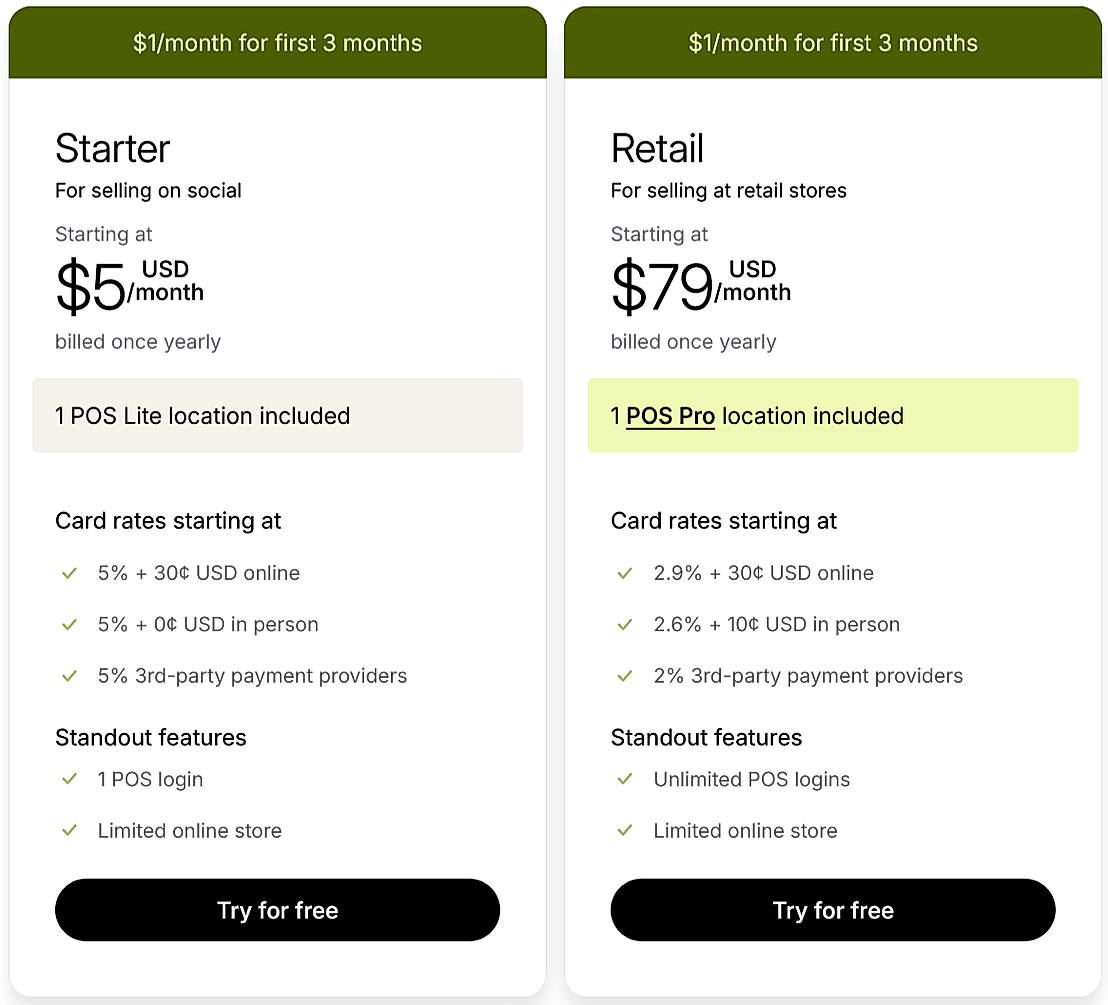
Shopify simplifies POS pricing by bundling software, hardware, and payment processing into a straightforward monthly model.
| Component | Shopify POS Lite | Shopify POS Pro |
|---|---|---|
| Software | Free with any Shopify plan (starts at $39/month) | $89/month per store location |
| Hardware | $0–$500 one-time (card reader, cash drawer, receipt printer, barcode scanner) | Same as Lite |
| Payment Processing | 2.7% per transaction (Basic plan) | 2.4% per transaction (Advanced/Plus plans) |
| Staff Permissions & Roles | Limited | Advanced |
| Reporting & Analytics | Basic | Advanced insights |
| Inventory Management | Standard | Multi-location, advanced control |
| Best for | Pop-up shops, kiosks, single-store sellers | Multi-store retailers, higher sales volume |
Pro Tip: Shopify POS Lite is automatically included in all Shopify ecommerce plans. If you’re already selling online, you can start selling in person immediately without extra subscription fees.
Shopify POS Lite vs Pro: Feature Deep Dive
95 % SW Score The SW Score ranks the products within a particular category on a variety of parameters, to provide a definite ranking system. Read more

What is Shopify POS and how does it work?
Shopify POS is a POS service that lets sellers accept payments from everywhere, be it in-store, online, or anywhere in between. This allows individuals and businesses to sell their goods or services without worrying about processing payments. The POS accepts all possible forms of payments, right from cash to credit cards of every major bank, solving a major pain point. The overall flow is fully automated as well, every payment that gets accepted via Shopify POS automatically updates the store inventory, orders, as well as customer data. Sellers can easily customise the pricing by adding discounts and account for taxes on the fly. Even the after sales service of processing refunds and sending receipts is all managed within the same platform. Moreover, setting up the POS system is seamless and can be integrated with devices of all kinds. An added bonus of using Shopify POS is that customers get a free Shopify online store within the same plan which offers a ton of additional benefits.
Read moreSW Score Breakdown
- Features 94%
- Reviews 97%
- Momentum 60%
- Popularity 60%
- Free Trial Available
- Starts at $5.0.
-
POS Lite: Best for mobile sellers, craft fairs, farmer’s markets, and pop-ups. It’s quick to set up and runs on an iPhone with Tap to Pay, minimizing hardware costs.
-
POS Pro: Designed for scaling operations — think multi-location stores, franchises, or high-volume retailers who need staff permissions, detailed reporting, and centralized inventory.
SaaSworthy Insight: For many businesses, the jump from Lite to Pro happens when they hire staff or open a second location. That’s when $89/month per store location becomes more of a necessity than an option.
Shopify POS Hardware Costs
While software is subscription-based, hardware requires a one-time investment. Typical pricing looks like this:
-
Card readers: $49–$349
-
Cash drawers: $129–$139
-
Receipt printers: $249–$369
-
Barcode scanners: $199–$289
Shopify also supports Tap to Pay on iPhone, which reduces upfront hardware costs for small sellers who don’t want to invest in full POS kits.
Transaction Fees with Shopify Payments
Shopify includes Shopify Payments in all POS plans, removing the need for third-party processors. Transaction fees vary by plan:
-
Basic plan: 2.7% per transaction
-
Advanced & Plus plans: 2.4% per transaction
This fixed-rate model makes it easier for retailers to forecast costs, compared to competitors who may have variable or blended rates.
Cost Scenarios: What You’ll Actually Pay
To make this more tangible, here’s what typical Shopify POS costs look like:
| Business Type | Setup | Monthly Software | Transaction Fees | Hardware | Total Monthly Cost* |
|---|---|---|---|---|---|
| Single pop-up seller | Shopify Basic ($39) + POS Lite (free) | $39 | 2.7% per sale | $49 card reader | ~$39 + fees |
| 2-store retailer | Shopify Advanced ($399) + POS Pro ($89 x 2) | $577 | 2.4% per sale | $700 in hardware | ~$577 + fees |
| 5-store chain | Shopify Plus (~$2,000) + POS Pro ($89 x 5) | ~$2,445 | 2.4% per sale | ~$2,500 hardware | ~$2,445 + fees |
*Excluding transaction fees, which scale with sales volume.
SaaSworthy Insight: For chains beyond 3–5 locations, the per-location fee can be a hidden cost driver, and this is where competitors like Lightspeed may become more appealing for retailers with large footprints.
Total Cost of Ownership (TCO) Advantage
Independent research by EY shows that Shopify POS delivers 22% lower TCO compared to competitors. That’s because:
-
No costly middleware integrations
-
Faster implementation (20% quicker)
-
Lower training and onboarding costs (21% less)
-
Reduced ongoing maintenance (16% savings)
SaaSworthy Insight: For small retailers moving from cash registers or manual systems, Shopify’s bundled approach significantly reduces the “hidden IT costs” often associated with other POS systems. For enterprises, the biggest cost saver comes from unified ecommerce + POS, which prevents data silos across sales channels.
Factors That Impact POS Costs
When evaluating Shopify POS (or any POS), retailers should factor in:
-
Number of store locations: Shopify charges per location, not per terminal—unlimited POS devices per store.
-
Number of users: Unlimited staff accounts at no extra cost.
-
Product catalog size: Unlimited SKUs on all plans.
-
Add-ons & apps: Advanced features may require Shopify App Store integrations.
Shopify POS vs Other POS Providers
| Provider | Pricing Model | Strengths | Weaknesses |
|---|---|---|---|
| Clover POS | Per-terminal fees, variable monthly costs | Strong hardware variety | Complex pricing, can add up quickly |
| Lightspeed POS | Higher subscription tiers | Feature-rich for inventory-heavy businesses | Higher implementation costs |
| Square POS | Free entry-level plan | Easy setup, ideal for micro-sellers | Limited advanced retail features |
| Shopify POS | Per-location model with ecommerce built-in | Native ecommerce + POS integration, predictable TCO | Per-location fees can add up for multi-store chains |
SaaSworthy Insight: Shopify’s biggest advantage lies in its all-in-one ecosystem. Competitors like Square may appeal to micro-retailers with $0 entry costs, but once you grow into multi-location operations, Shopify Pro often becomes the more predictable and scalable option.
What Redditors Think About Shopify POS
Reddit discussions reveal a mixed but insightful picture of Shopify POS:
? “I went from signing up to taking in-store payments in a single day. No other POS was that simple.” — r/smallbusiness
? “2.7% feels steep when margins are thin, but Shopify Payments saves me the headache of managing third-party processors.” — r/retail
? “We scaled to 4 stores and the $89 per location adds up fast. That’s when we started looking at Lightspeed as an alternative.” — r/Entrepreneur
Reddit takeaway: Shopify POS is generally seen as best for Shopify ecommerce users and growing retailers who want simplicity and integration. For single-store owners looking to minimize fees, Square often comes up as a cheaper alternative.
Reddit takeaway: Shopify POS is generally seen as best for Shopify ecommerce users and growing retailers who want simplicity and integration. For single-store owners looking to minimize fees, Square often comes up as a cheaper alternative.
SaaSworthy’s Expert Verdict
Shopify POS is one of the most cost-effective and scalable retail POS systems in 2026. It works well for small sellers testing in-person sales (with Lite included free) and multi-store retailers needing enterprise-level efficiency (with Pro).
The combination of transparent pricing, unlimited staff accounts, lower TCO, and unified ecommerce integration makes Shopify POS a strong choice for both new and growing retailers.
If you’re already running an online store on Shopify, adding POS is a no-brainer. If you’re evaluating standalone POS options, Shopify still delivers one of the best cost-to-value ratios in the market—though fees can scale quickly for high-volume, multi-location operations.
FAQs on Shopify POS Pricing
How much does Shopify POS cost per month?
Lite: Free with Shopify plans (starts $39/month).
Pro: $89/month per store location.
What’s the difference between POS Lite and Pro?
Lite works best for temporary or small-scale sellers.
Pro is for retailers with permanent stores, staff management needs, and advanced reporting.
Are there hidden fees?
Shopify pricing is transparent. You only pay for your software plan, hardware, and transaction fees.
Do I need Shopify Payments?
No, but using a third-party processor adds extra transaction fees.
Can I use third-party hardware with Shopify POS?
Some third-party devices are supported, but compatibility is limited. Most users prefer Shopify-certified hardware for guaranteed support.
Is Shopify POS available outside the US?
Yes, but hardware availability varies by country. Transaction rates also differ by region.
