

When you take on a project as a business, it becomes an intricate and detailed procedure that you need to go through along with your team. Every phase becomes important and it impacts the action that needs to be taken to reach the ultimate goal. This entire process, including the phases and stages, makes the project life cycle. As you may have understood, it starts when the project is initiated and lasts until the project is over.
The reason why knowing and understanding a project life cycle is essential for project management is because it gives you an idea about how much progress a project has made, how long it would take for closure, and many other relevant but important information.
The factors of a project life cycle depend on various other elements, along with whether it may be a plan or change-oriented. To understand the project life cycle better, we have compiled all the necessary information that you need to know. Let’s get started.
Table of Contents
Phases of a Project Life Cycle
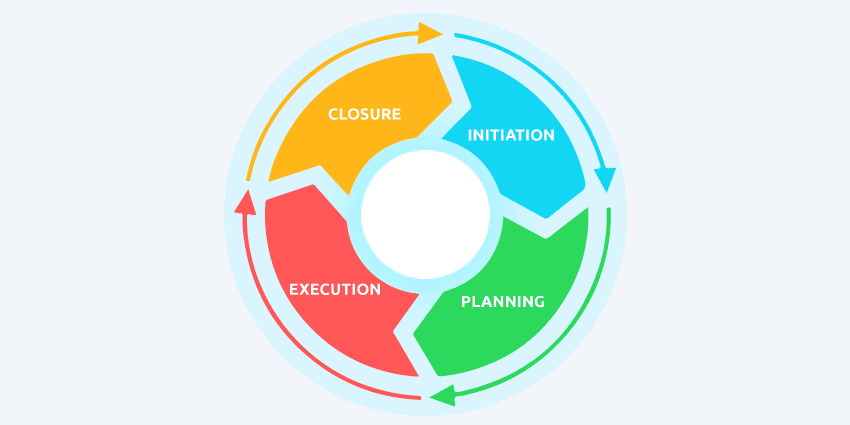
Let us first clarify that the life cycle of a project is highly versatile and varies from project to project, department to department, and even company to company. It is a highly flexible procedure that needs to be tweaked as and when required. Therefore, it becomes challenging to name out permanent phases of the procedure.
Yet, there are a few phases that are considered basic and within which almost all projects can be divided into. These phases are as follows:
Initiation Phase
This is the phase where it all begins. The project is authorized, defined, and given a basic meaning here. All the necessary and required documents, including the Project Charter, are created here.
The Project Charter is an important document that contains all the necessary information about the project. Without the Project Charter, the project will not be authorized. That said, here is what a Project Charter includes:
- The purpose, mission, and vision of the project
- Immediate objectives and the standards for success
- Details about the sponsors and authority for the project
- Detailed information about the project specifications, terms, and basic risks
- Information on related stakeholders
This is an important phase as this decides the essence and purpose of the project.
Planning Phase
The next step is where all the details are laid out. This phase decides which strategies to adopt, the procedures and methods to be used to achieve the goals and other such specifics.
If the initiation phase is an introduction, the planning phase is all about constructing the mold for the project. In the planning phase, planning consists of two main ingredients:
- Strategic planning: Here, the overall ways to complete the project are laid out and constructed.
- Implementation planning: Here, those decisions are laid out via which the approaches in the strategic planning stage are to be achieved.
Execution Phase
The execution is, as you might have guessed, the phase where all the strategies laid out in the planning phase are put to work to obtain desirable results.
Through the means of monitoring and controlling, the project manager supervises the team under them to execute the plans. Each member is given proper roles and tasks which they must complete for the project to be successful.
The project manager also looks for any mistakes and errors, if there are ones, and ensures they are rectified. Once the plans are carried out, the project manager waits for approval from the sponsors, authorities, customers, and stakeholders related to the project. Once the project is approved, the next phase is initiated.
Closure or Termination Phase
The last phase is called the termination or closure phase. Here, once the project is approved by the designated authorities, the last bits are wrapped up, and the project is officially announced as completed.
In this phase, the project manager is responsible for disbanding his team, either relieving the members of their roles or assigning them new roles for a new project. Also, all borrowed resources are returned to their respective owners.
This phase also acts like a reviewing phase where the project manager, along with their teams, looks back at the course of the project and analyses it.
They look into whether they could meet the objectives set out in the first phase, which methods were the most effective, what mistakes were made, and how they could have made it better. Such insights help the members and the manager to get more experience and knowledge that could be applied in future projects.
The Generic Project Life Cycle

The generic project life cycle displays certain characteristics which are common for all types of projects. This life cycle is only applicable to upper management or individuals who are not too familiar with the project. But it can still provide a basic standard to measure and compare different projects, despite the department or objectives. Let us take a look:
- At the beginning of the cycle, we notice that the funding and resources for both staffing and budget are low but initially increases and peaks when the project is in its execution phase.
- Near the end of the cycle, the said funding and resources start declining as the project nears its closure.
- However, the typical curve for staffing and budgeting cannot be applied to all cases and projects. It is so because a specific budget is required to obtain resources pertaining to the project in the early stages of the project.
- In the beginning, the level of risks and uncertainties is at its peak but starts to decline as the project objectives are met, and results are delivered.
- The probability of impacting the final results without altering the budget is high in the early stage. However, as it nears its completion, the probability decreases eventually.
As mentioned earlier, these features are common in almost all types of projects and provide a base for comparing and measuring. The main reason to form adaptive life cycles is to simply keep the interest of stakeholders high and low cost of changes throughout the project life cycle. With that said, let us see how this information is beneficial to an organization:
- The information from this helps the teams to be more proficient, precise, and look for more profitable ways
- The information assists the organization
- With this information, communication gets better and easier
- It helps in forming reports and analysis of previously undertaken projects, which gives better insights for future projects
Summing it up
In the end, if you need to get the best out of your projects, it is essential for you to first understand the project life cycle like the back of your hand. The phases described during the project life cycle can help you determine which task to carry out when. It is also an excellent tool for resource and budget allocation.
With intricate knowledge about the project life cycle, one can also produce informative reports and analyses that can help future projects, minimizing errors and increasing the experience of the team. Another tool that a manager or business owner must consider for their teams and business is Project Management Software. It is one of the most essential tools in today’s time that lets you handle big and small projects with ease and efficiency.
