

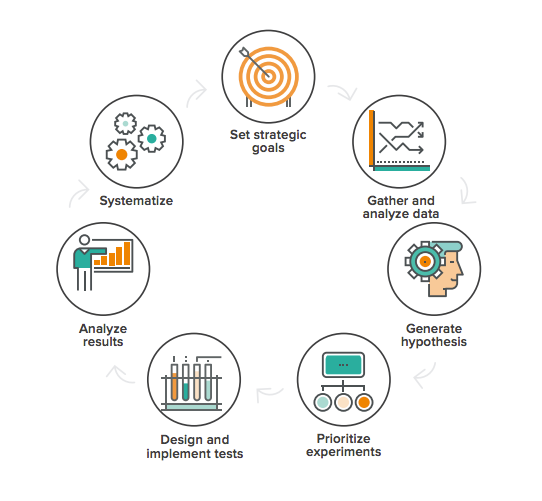
Developing and advancing a product doesn’t usually revolve around one-off strategies, insider facts, or hacks. Sustainable development stems out by building an ‘unquestionable must-have’ insight and afterward carrying out a thorough course of experimentation to find the exceptional mix of strategies that work for your project, crowd, and your organization’s plan of action. However, before you jump into every day of your testing cycle, take a step back to layout your essential objectives and sort out some questions that always linger around every project goal. And these questions are:
- Where do you need to go?
- At what point do you need to get there?
- Are your plans laying well with time?
- How will you scale achievement?
Yet, how would you do that precisely? We suggest utilizing the Objective and Key Results framework called the OKR system.
Table of Contents
What is the OKR strategy for Growth Teams?

OKR framework is a goal-setting strategy adopted by various growth teams of different organizations. This concept was first introduced by Andy Grove, a former Intel president, and John Doerr, a Google investor, and a venture capitalist. It was used to scale the success rates of companies as well as to record a to-do list for the growth team members. This concept was later popularized by high-tech companies like LinkedIn, Zynga, and Google.
An OKR comprises of two parts:

- Objective (O): It refers to the things your company wants to achieve within a specific time frame; it could be a year, month, or even a quarter. Objectives tend to be precise, concrete, short, and, most importantly, inspirational.
- Key Results (KR): The KR part is the key result. If objectives are your dreams, they are a barometer to measure them. This part is quantifiable as it measures whether you majestically succeeded or miserably failed. They are deliverables to your objectives, each of your objectives should be accompanied by at least three to five key results.
A general formula for your OKR could be:
OKR: I want to achieve (objective part) under the measurements of (key results).
Now that we are past the definition, let us move forward to its working, let us know how to set a definitive and concrete OKR.
How to write Objectives in OKR for Growth Teams?
Objectives are set keeping in mind the things that, if improved, would have a major impact on the company’s growth curve. There are various areas under a customer life cycle that could substantially alter the growth curve of your company. These areas are:
- Activation
- Acquisition
- Retention
- Referral
- Monetization
All these areas collectively affect the growth graph of a company and deciding which one to target can significantly affect your entire market standing. So, let us see how to set up objectives for your company’s growth.
Step 1: Choose a customer life cycle area
You need to focus on one area among all these different areas: Activation,
Acquisition, Retention, Referral, and Monetization. Keep in mind that there are no wrong decisions; each area will have an entirely different impact on the growth curve.
Step 2: Set a time constraint
Once you are done choosing among the five customer life cycle areas, you need to limit your goals within a time frame. The aptest choice is to set a time constraint between 30 to 90 days. Anything less than 30 days would not stand corrected as it would run short of time. On the contrary, anything more than 90 days would not be considered efficient as it would appear like a drag pushing your team into boredom and can thereby cause loss of work motivation.
Step 3: Draft the objectives
Now that you are through with the whole concept of time and focus and area choices, you need to sit and jot down the goals you need to bag.
An objective should have the following characteristics:
- It should be precise and simple, nothing more than two lines.
- Your team’s objectives should focus entirely on your team’s capability and competence, and caliber. It should be independent of other team’s work practices. This is done to avoid any delays or conflicts between two separate teams when one of them is not able to accomplish their goal because of the other.
- Objectives should be inspirational and qualitative in writing.
Example: Let us suppose you work at a social media marketing company called Bozo. So an example of an appropriate objective could be:
Objective: Make Bozo’s annual turnover reach 2 million dollars by 2022.
How to write Key Results in OKR for Growth Teams?
The next component of the OKR framework is the key result. The key results are quantifiable entities that measure whether your objectives scored a goal or not.
Considering the same example as mentioned earlier in the objectives section, we can draft the key results like:
- Engage at least 40 percent of the users
- Get a review score of 8.5
- Up your activation rates by 10 percent
Descriptive OKR examples as designed by Growth Teams
Here we will be discussing some OKR templates that will give you an idea of how to draw OKRs correctly. The fundamentals of OKR have been explained so far, now let us delve deep into their specifics and writing formats. Here we go:
CEO level OKR Examples
Since OKRs are utilized to adjust all groups to an association’s top objectives, your whole organization’s OKRs are just pretty much as powerful as the ones you set at the extreme top. Therefore, it becomes imperative to ensure you’re defining CEO-level objectives viably.
To ensure this, read some of the CEO level OKR examples listed below:
Objective 1: Make a 10 million dollar sale in bookings
Key Results:
- Generate at least 60,000 leads by the quarter of the year
- Bag 5,000 deals worth 10 million dollars by the end of the year
Objective 2: Expand our brand
Key Results:
- Up our revenue figures by 1 million dollars
- Substitute churn rates by growing customer success
- Cutback on extra expenses
- Launch a new product soon
Objective 3: Launch a new product by the end of Q3
Key Results:
- Hold a place in some renowned marketing Magic Quadrant
- Work on advertising
- Peruse 30 customer case studies by Q1
- Rewarded at an industry conference
Objective 4: Ensure customer satisfaction
Key Results:
- Boost our NPS scores to 9 by Q1
- Gather customer feedback monthly
- Track loyal customers and extend extra facilities to retain their loyalty
- Hike our customer retention rates to 95 percent
Objective 5: Maintain a robust corporate culture
Key Results:
- Design a mentorship program
- Launch the mentorship program by the end of Q2
- Boost our employee satisfaction scores to 9
- Maintain high employee satisfaction scores (8 or higher)
- Conduct weekly surveys to hold a two-way feedback loop
Marketing level OKR examples
The growth team has to look over numerous areas to design objectives and scale them within definite key results. So let us have a look at some marketing-level OKRs.
Objective 1: Increase the rates of MQL (Marketing Qualified Leads) generation
Key Results:
- Use Account-Based Marketing to generate net-new unique leads
- Get 50 new MQLs via organic keywords and search
- Get 150 new MQLs via AdWords
- Get 100 new MQLs via email marketing
- And 200 new MQLs through social media marketing
Objective 2: Enhance our website’s conversion rates
Key Results:
- Up our conversion rates via landing page by 15 percent by the end of Q1
- Increase visitors to the website by 5 percent every month
Objective 3: Introduce a renowned newsletter
Key Results:
- Score 3 percent CTR
- Successfully launch 3 newsletters
- Ensure the newsletter are popular among the netizens
Wrapping Up
The aforementioned sections highlight how OKRs fundamentally revolve around a company’s growth pattern and how growth teams effectively implement them to record success or failure. OKRs have been around the corporate market for years now, and all they have done so far is unite, inspire, support, and uplift the team members into accomplishing what they need to in order to bag success. OKR approach helps an organization in various ways like:
- Instilling a sense of clarity
- Providing a common language in terms of objectives
- Passing on a purpose
- Compelling priorities
- And most importantly, implanting the idea of growth and development into your team’s mind.
Thus we see OKRs are an essential aspect of a corporation’s everyday grind. OKRs are essential for everyday inspiration; if you wish to see more of such OKR examples, check out our blog on OKR examples for the operations here!
