

Though the Covid-19 pandemic brought the entire world to a standstill, it also forced people to look at technology in a new light. Technology has always been a part and parcel of our lives; however, the boom it received during the pandemic has helped several businesses change their course of operations. Technology has helped different types of businesses and their employees to bounce back successfully. Today, digitization has become the keyword across businesses of all shapes and sizes. This digitization coupled with automation has helped businesses transform the way they function and perform.
One such area of growth is Industrial Automation. Now, industrial automation has been in the picture for quite some time now, but businesses looking at making their production line more efficient while ensuring low operational costs, have resulted in a great boom in industrial automation. Also, with new technologies making their way into the market, the need to adopt automation is only increasing day by day. It is expected that by 2027, the industrial automation market will reach about $306.2 billion!
With such positive growth, it is not surprising to see that the majority of businesses are taking advantage of various automation technologies to improve their operations, address their customer needs, and stay ahead of their competition. Read on as we explore more about industrial automation, and it is being used to achieve business transformation.
Table of Contents
What is Industrial Automation?
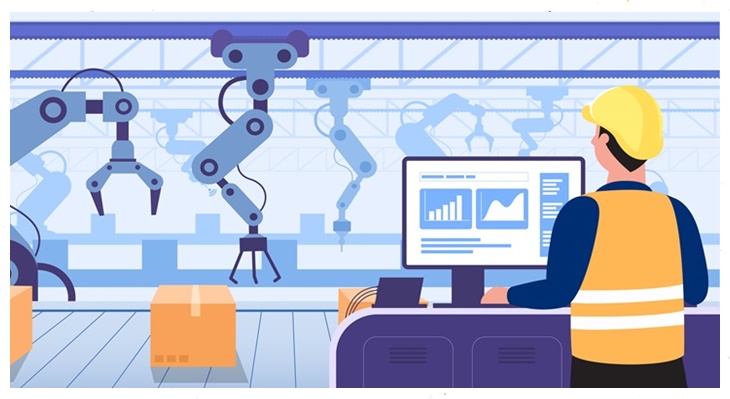
In simple words, industrial automation can be described as the process of implementing automated processes, various digital technologies, computerized machinery, etc., to reduce manual efforts and achieve improved efficiency and productivity. Industrial automation is quite common in manufacturing industries where they use both hardware and software to streamline various processes related to production, assembly, material handling, etc.
With industrial automation in place, businesses can provide better quality end products. According to various reports, it is believed that the first use of automation in industrial business was in 1947 which slowly led to the building of the first industrial computer system in 1959. Over the years, there were several breakthroughs as a result of various technological advancements. Industrial automation is built on two main foundations: control systems and control networks.
Control systems are considered one of the foundations of industrial automation because they help in managing, monitoring, and directing the automated tools to perform in a certain way. These control systems comprise various input and output devices, such as valves, pushbuttons, pressure switches, etc., and programmable logic controllers (PLCs). In order for these control systems to perform their respective job, they need to be connected to a network so that they can seamlessly communicate with each other.
Control networks, the second foundation of industrial automation, act as a unified path through which all the various software applications, automated tools, control systems, etc., are connected on one platform. This central platform enables the seamless transfer of data and communication.
Apart from these two major foundations, here are some of the other primary components of industrial automation:
- Supervisory Control and Data Acquisition (SCADA)
- Distributed Control System (DCS)
- Human Machine Interface (HMI)
- Programmable Logic Controller (PLC)
- Programmable Automation Controller (PAC)
- Artificial Neural Network (ANN)
- Robotics
There is no doubt that industrial automation is here to stay, which means that businesses should try to take advantage of it as much as possible and implement it to make their businesses more efficient and productive.
What are the Different Types of Industrial Automation?
With its wide range of use, it is not surprising to see that industrial automation can handle a large number of tasks. Though its usage is widespread, industrial automation can be distinguished into four major types.
- Fixed Automation – This type of industrial automation is used to increase production rates. This type of automation comprises a fixed set of repetitive sequences. It is one of the most common types of industrial automation as it helps businesses to improve their efficiency, boost their operational speed, minimize human error, and is cost-effective.
- Programmable Automation – This type of automation is similar to fixed automation; however, the difference lies in the fact that its automated tasks can be reprogrammed as needed. It is mostly used in machines that involve assembly processes.
- Flexible Automation – Flexible automation can carry out most of the operations performed by programmable automation; however, unlike programmable automation, flexible automation does not comprise any lengthy reconfiguration process. It is much easier to input any changes as this type of automation uses a centralized computer operated by humans to control and make changes to any of the processes.
- Integrated Automation – Integrated automation involves several tools and technologies which help businesses to automate their processes through one, single control system, thus, eliminating the need for any human intervention. Used in a wide range of industries like beverage manufacturing, plastic processing, packaging, etc., this automation enables businesses to keep everything in sync. Some of the technologies involved include flexible machine systems, computer-aided design (CAD), conveyors, robots, etc.
Where is Industrial Automation Commonly Used?
Industrial Automation is today one of the fastest-growing technologies and as it continues to expand its capabilities, more and more industries are adopting it to improve their overall efficiency. With its goal to help businesses boost their production speed while minimizing their costs, this automation technology is typically being used by large factories and industries. However, its wide range of functions is something that can benefit small and mid-sized companies as well.
The role of industrial automation in business transformation has been huge and it has truly made an impact on not only how businesses operate, but also on how the information is disseminated on a wider scale. Today, industrial automation has become one of the key technologies for different types of industries. Here is a brief list of the various industries where industrial automation has left its mark and continues to do so.
- Agriculture
- Healthcare and medicine
- Mining
- Transportation
- Manufacturing
- Steel and Paper Mills
- Food Service
- Oil and Gas
Whether you are in the business of product creation, fleet management, pipeline monitoring, crop fertilization, paper plant control system, or any other operations, with industrial automation at the helm, you can completely transform the way you carry out your various processes and tasks and make them more productive and cost-effective.
Industrial Automation Systems Hierarchy
In this section, we will take a look at the industrial automation systems hierarchy which will allow you to have a better understanding of how this technology works. The industrial automation hierarchy consists of four different levels and every system, device, and software falls under one of these levels. Below are the four levels of the industrial automation systems hierarchy.
- Field Level – The bottom-most level in the hierarchy is known as the field level which is where various machine monitoring and physical actions happen. This level consists of field devices and equipment like sensors (flow meters, pressure, temperature, etc.) and actuators (direct current motors, flow control valves, etc.). The sensors help in transmitting real-time data and the actuators help in converting the electronic signals into automated tasks.
- Control Level – The next level is the control level which comprises the execution of mechanical operations. This is the level where you will find automation controllers like PLCs (CPUs, communication modules, etc.) and CNC machines (grinders, drilling, plasma cutters, etc.). The PLC and CNC machines use the data provided by sensors to direct the actuators to perform the required functions.
- Supervisory Level – The supervisory level which falls into the upper tier of the industrial automation systems hierarchy is the level wherein the devices and systems are provided with more control over the automated tasks. It includes different types of technologies, such as human-machine interface, distributed control systems, and supervisory control and data acquisition system. These technologies together perform a wide range of functions.
- Enterprise Level – The top-most level in the hierarchy is the enterprise level where the overall system is managed. Compared to the other levels in the hierarchy, this level focuses more on the commercial aspect rather than technologies. One of the key aspects of this level is data collection using which businesses can gain valuable insights about all their automated processes and take key decisions accordingly. To do so, most businesses rely on an Enterprise Resource Planning (ERP) system. This data moves across various communication channels like ethernet, serial communication systems, and field buses. The data and insight gathered from it enable businesses to perform market and customer analysis, focus on production planning, etc.
Advantages of Industrial Automation
Though initially, industrial automation did face some hiccups, it has been successful in making its impact, thanks to the wide range of advantages it offers. Here are some of the key advantages of industrial automation:
- With the majority of the tasks automated through industrial automation, businesses have been able to increase their return on investment (ROI).
- Automating processes and tasks have helped businesses reduce their operational costs since there is less usage of labor, resources, and energy consumption.
- With advanced analytics and real-time capabilities, businesses have access to more accurate data.
- One of the key advantages of industrial automation is that it helps in minimizing human errors and helps in maintain a stronger and more reliable process/system.
- The automation results in quicker output, thus allowing employees to focus on other tasks.
- The automated processes are also equipped with stringent quality check controls to ensure improved product quality.
- The automated systems can perform a wide range of functions, enabling businesses to minimize their dependency on third-party vendors.
Disadvantages of Industrial Automation
Like every other system, industrial automation also comes with its share of disadvantages. No matter how foolproof you think your systems are, there is always a scope of error and disadvantage when it comes to devices and equipment. Here are some of the disadvantages of industrial automation.
- Though implementing industrial automation is cost-effective in the long run, the initial setup of hardware and software is expensive.
- With automated tasks and processes in place which aim to reduce human intervention, there is a large scope for unemployment and a diminishing workforce.
- Hackers are also taking advantage of the new tools and technologies which can lead to security vulnerabilities.
- With industrial automation, there are limited customization options which limit the scope for changing the versatility of the output.
- The automated hardware and software implemented require regular maintenance to ensure they are performing to the best of their abilities.
Why does Industrial Automation Matter?
Automation has truly evolved the way businesses operate today and the Covid-19 pandemic has only proved why automation is the need of the hour. To summarize, here are the top three reasons why industrial automation matters and why you need to adopt it as soon as possible.
- Industrial automation boosts productivity – This technology has been credited with boosting productivity massively across various industries and factories. Tasks that earlier required a major chunk of the workforce can today be performed with just a fraction of that workforce. Apart from reducing labor costs, digitization has also helped in putting efficient machinery in place, adjusting output as required, reducing errors and risks, and consistently yielding high-quality products.
- Growth of industrial workforce – The lockdowns and social distancing rules emphasized the need for tools and technologies that could help employees and staff access, monitor, and operate control systems, machinery, and other equipment remotely and from a safe distance. With automation in place, businesses could ensure that their staff is able to remotely perform all the key activities, such as making data-driven decisions, improving real-time operational efficiency, adjusting output with better accuracy, etc.
- Impact on the Environment – By combining industrial automation with various energy management technologies, industries can better control the impact their factories have on the environment. With the help of digital automation tools, they can manage their resources, production, and other business processes in an eco-efficient manner. By having a central command point, businesses can gain better insight into how and where they can minimize waste and save energy.
Conclusion
The demand for automated services, software, devices, and equipment is only going to increase and this, in turn, will make industrial automation an invaluable asset. Today, stakeholders, employees, and customers require quick turnarounds and for businesses to cater to this need, they need to adopt industrial automation. Hence, it is recommended that businesses conduct thorough research on which combination of technologies, hardware, software, and infrastructure can help them achieve long-lasting results in a cost-effective manner.
Check out SaaSworthy to know more about software that can help you build a better and more successful business.
