

With SaaS Talks, our aim has always been to tell the stories of those who have been in the trenches, their learnings, how they overcame their challenges, and more. And it was our privilege to interact with notable entrepreneur Beerud Sheth, who has been known for having the foresight of the rise of freelance work with Upwork (formerly Elance). After Upwork, he started Gupshup as a consumer-centric free SMS service, which was later pivoted to a B2B-focused messaging platform. Today, with the rise of conversational commerce and chatbots, Gupshup is a SaaS company to watch out for. We talked to Mr Sheth about Gupshup’s evolution, what makes it stand out, his experience as a second-time entrepreneur, and the way forward for Gupshup.
PS: the interview has been edited for the sake of brevity.
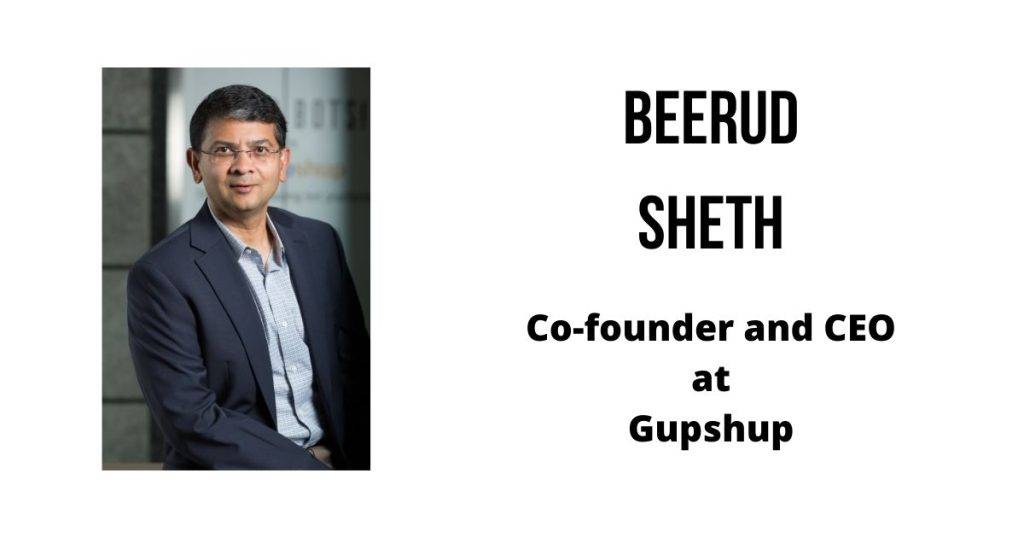
Table of Contents
1) You have an illustrious career, so I wouldn’t ask you to share your journey. But I’d be interested in knowing what attracted you towards SaaS as a business model?
I wish I had a clever answer, but I think I just stumbled into it, not by design. I think we were actually building a consumer service that then pivoted into a SaaS model – consumption SaaS in particular. As an entrepreneur, you have the cards you’re dealt with, and then you maximize them. You see what’s good about it, and what’s not so good about it.
So a consumer business model can scale from zero to a hundred instantly, but SaaS can’t do that. On the other hand, the consumer model can crash and burn, but SaaS doesn’t do that. So it’s sort of slow and steady wins the day. So I guess we had only multiple races, but SaaS is about slow, steady, incremental growth while listening to customers. Onboarding a customer can also take time, but once they’re in, it’s sticky. Most importantly, a consumption SaaS model can scale nicely, even faster than subscription SaaS – as a business grows, its volume grows, and therefore our revenues grow. I think it’s also natively suited for India’s strengths because you can deploy a lot more resources to customize and optimize for different industry verticals and geographies and different use cases and things like that. You’re going to have a huge wave of SaaS companies coming out of India. It’ll be kind of if outsourcing was the first wave of tech in India, SaaS will be the second wave of global tech. Of course there’s are a bunch of companies building for the local market. But if you talk about at a global level, SaaS will become a prevalent force for the subcontinent. Freshworks and Zoho are great examples, but I think, there’ll be many more coming up as well.
2) Could you share Gupshup’s evolution over the years?
So we saw the power of SMS that enables the reach to billions of users. So first we started the consumer service that was from 2007 to 2010, and then we pivoted to an enterprise model. And since then, we’ve stayed focused on it, but the industry itself is changing.
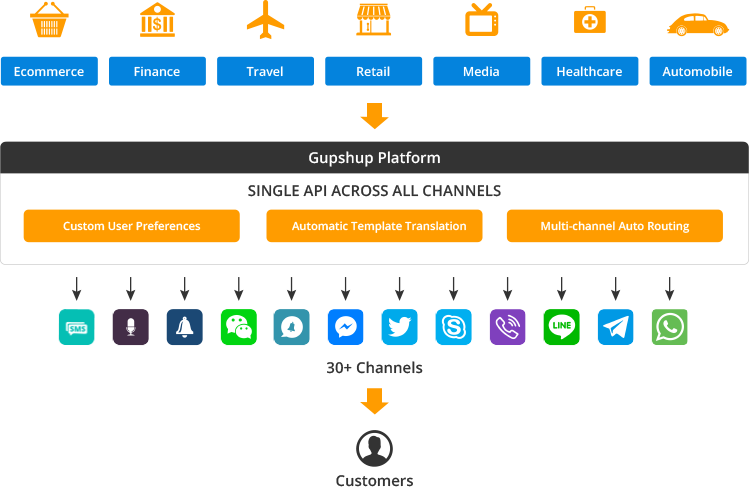
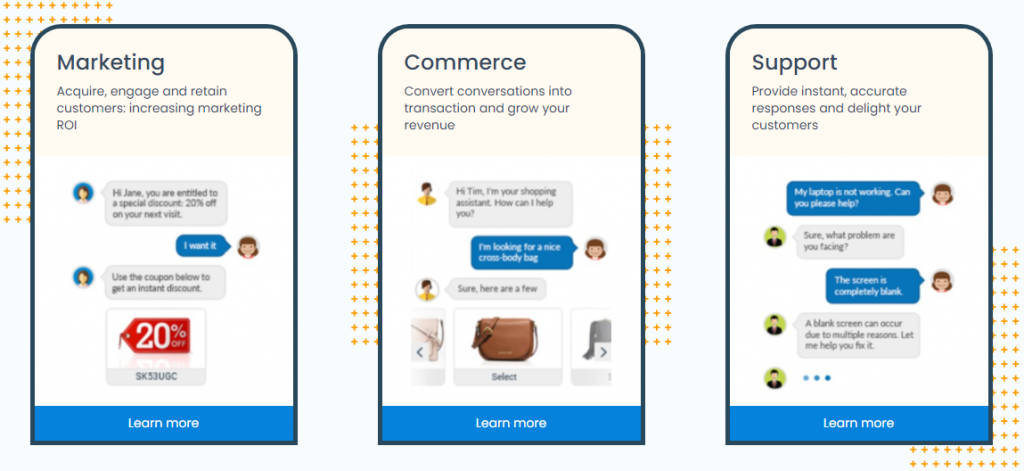
For the longest time, it was all about SMS, and it’s great because it’s truly ubiquitous. But the user experience is limited to 160 characters of plain text. Additionally, it can only do one way kind of notifications. But now there are newer messaging channels like WhatsApp, Instagram, and then we’ve launched something called GIP (Gupshup IP) and so on, which enables richer interactions and two-way conversations. That opens up a whole new set of use cases like marketing, commerce, customer support, and so on. So the space is just seeing explosive growth, a lot of new use cases, and several opportunities. And we are just scaling into it. So I think the evolution really is from consumer to messaging 1.0 to messaging 2.0, which we also call conversational messaging.
3) How many businesses are using Gupshup? What are your biggest markets?
Gupshup is being used by tens of thousands of businesses. But what we count more carefully instead of the number of businesses is the transaction volume. And we are handling between six to 10 billion messages a month. It’s a very high scale messaging volume and it’s increasing rapidly. The good thing is that traditionally, a lot of it was enterprise-focused because they tend to have higher volumes. For example, a big bank will have 100x the volume of smaller businesses. But now with the new technologies and conversational messaging, we are seeing growth in many different areas.

We’re in 20+ countries – Latin America, Southeast Asia, the middle east, Europe, and the USA. And we’re rapidly expanding in many different directions.
4) Gupshup didn’t raise money over a decade, and this year, you already had two funding rounds. What made you accelerate the growth?
Part of the reason was we kept changing and evolving with time, and the other was that the world changed. As far as we’re concerned, we were steadily growing and revenues were growing too. We were also innovating as I referred to earlier the evolution to messaging 2.0 where the newer channels offered conversational experiences.
So we wanted to be on the cutting edge of messaging technology. It’s what we’ve been doing for many years and we were steadily growing by executing on that. Meanwhile, the pandemic happened which forced, businesses, or any kind of offline activity to go digital. Therefore, as digital businesses grew, we grew, and we witnessed enormous growth in our business.
Meanwhile, the fed pumped a lot of money into capital markets. So you had private equity funds with a lot of capital looking to invest in growth which we had and it’s sort of all the stars aligned. Suddenly, we got a ton of capital, raising $340million in total. Once that’s happened, the flywheel is in motion because we use the capital and invest more to scale the business even further, which makes it an even bigger and higher growth business, and so on. And as they say, as entrepreneurs, you have to maximize your return on luck, i.e. ROL, just like ROI.
Related read: SaaS Companies That Got Funding in 2021
I wish I could say that we intelligently planned these funding rounds, but what’s more important is that the planning that we had, and the nimbleness and the sort of agility that our organization had, we were prepared for many kinds of scenarios. And when the pandemic happened, we adapted very quickly and aggressively, and now, we are scaling up.
5) When it comes to chatbot software, there are a lot of players in the market. What makes Gupshup stand out?
Before Gupshup, there were traditional SMS messaging platforms. As the space evolved, we always saw ourselves as a Silicon Valley-style company with a lot of deep software and product tech capabilities. We were always pushing the limits of messaging technology.
We were the first to WhatsApp, we launched GIP, and we were the first to offer Instagram messaging to businesses. We are now an RCS leader as well. And we built out one of the first chatbot platforms. So we were doing a lot of evangelism and thought leadership, and we’ve just always been pushing the limits of messaging technology. Most of the companies don’t have that ability, whatever may be the reason – whether they don’t have the talent, vision, mindset, or perhaps the strategy – to do things like this.
So compared to existing players, we were able to really scale and stand out. And then there are some newer players now who don’t do messaging – they just offer chatbots. Right. Compared to them, we have the advantage of the messaging, and an incumbent leadership. We have deep relationships with enterprises and we can provide them the whole thing, sort of a one-stop solution. And a chatbot company cannot do so.
So as I mentioned before, we had a unique vision that messaging 1.0 is evolving into messaging 2.0. And it’s not a separate thing – it’s an extension of traditional messaging. And we are by far the leading dominant player in this space.
6) Could you shed a light on your marketing strategy?
In general, our marketing strategy includes a lot of evangelism and thought leadership. Of course, we rely on all the tactical stuff around SEO, SEM, and social media as well. We also do a lot of events, conferences, and PR. So those are the marketing elements, and then you have the sales take over once there’s a good lead.
7) What’s next for Gupshup? You recently acquired Dotgo, are there any new features or acquisitions in the plan?
The next thing that we already have is massive. It’s going to keep us busy for a decade or two. Most people don’t understand the significance of it. So let me explain. What’s happening right now is a little bit like the web in the mid-nineties. When the web came about, businesses realized that consumers are looking to shop through the browser. It became the digital storefront where other people were coming in, browsing for products, and transact and all that stuff, or read content, and buy and sell in the marketplace, and so on.
So, over time, every business had to build a website and had to do different kinds of things? Different use cases… for marketing, for commerce, for support, and all that. And even today, 25 years later, you know, we are still, there’s a huge industry of building newer and better websites. You still have WordPress, you still have Shopify and it’s by no means, it’s over.
Conversational experiences will be the next digital storefronts for businesses
So if you look at it today, with the rise of smartphones, and on those devices – the rise of messaging apps, consumers are sitting in their chat apps, looking to chat with businesses, just as easily as they chat with their friends and family. So businesses are realizing, this is the new digital storefront – chatbots and conversational experiences. This is where you’re going to get the new footfalls, or eyeballs so to speak. Therefore, I think similarly for the next twenty-five years, it’s still going to be building chatbots and conversational experiences, which will get more and more advanced over time because they’ll work on different channels, they’ll have rich media and embedded experiences, they’ll have conversational AI and natural language processing, and they’ll do marketing, and commerce beyond just support at the moment. They’ll also do relationship building and customer engagement. So this is the next big thing and it’s massive. So this is going to keep us busy for a plenty long time. We are not thinking about what’s next after that. I think this alone has to play it out.
So what we have to do then is to democratize access, meaning build tools that make it easy for merchants to do it? If you think about it, even a blogging website or a microblog, which became Twitter or a personal webpage, which then became Facebook and social media, these are all variations of websites? So building tools and templates and standard things and wherever we see hugely repeating patterns. We specialize in and build it out right, as opposed to the business having to do it. So our job is to build these tools and make them easily available and accessible for every business, every brand – whether it’s small or large, in any region or industry. There’s so much tooling and plumbing required to enable these conversational experiences.
We also have an active pipeline of acquisitions, and we’ll announce the right things at the right time.
8) What has been your biggest learnings as a second-time entrepreneur?
As an entrepreneur, as you grow, evolve, and mature, it can actually be both good and bad. So the good thing is you know what to expect, so there’s less panic or less of a rushed reaction. You don’t freak out as much anymore. You know that you’ll be able to deal with that, or the fact that it’ll take some time, but we’ll get through it. So you have that quiet confidence. You have the maturity, and can keep the long-term perspective as opposed to the short-term issues. You also have stronger networks, credibility, more trust from investors, and employees, All of this makes a lot of difference. You also get a little more media coverage – and all those are good things.
But there are bad things too. Sometimes, a repeat entrepreneur can have a deluded sense of self-confidence or even arrogance. They’d say because I succeeded in X, I can now succeed in Y. That’s not a given by any stretch, and it can give you a false sense of confidence in what’s about to happen. So you have to work harder to maintain that intellectual humility to say just because X happened, doesn’t automatically imply that Y will also succeed. That’s because the new customer of the second company doesn’t care about your track record. They will care about whether the product works properly or not. It’s as simple as that. So, you know, all your track record and experience go out the window when you engage with the customer. So I think. That is harder as a second-time entrepreneur, right. Or somebody might say, oh, I don’t want to deal with all this grunt work. Right. Because I’m already successful or maybe I’ve had an exit and I made some money.
And this is where young entrepreneurs have a huge advantage because they’ll do whatever it takes, as an entrepreneur should. As a repeat entrepreneur, you have to leave your ego at the door or your success at the door. It doesn’t matter what you’ve done, what you’ve had. It’s a bit like if I scored well in the last match doesn’t mean that it’d be easier to score in this match too. You really have to stay focused, work hard, and fight for every run. So if we can keep that level head, then your experience is a huge advantage.
9) What are your favorite SaaS software out there?
I may not use a lot of SaaS software, but I admire their strategies. Salesforce was innovative and visionary in its own time. Twilio’s done extremely well. Then there’s Snowflake, or even all the cloud companies. AWS is really big too.
What’s exciting for me is also the consumerization of the enterprise. Meaning the old world of enterprise software was that you sell software licenses, it takes six to 12 months to sell something, and it would be very complex. A lot of companies would buy the license, but never use the software, etc. With SaaS, it’s become quick and easy. You get like freemium, you can try a product before you buy, you can pay per seat, or pay as you go. So this has made SaaS companies value product capabilities, and design. Even the business models are evolving – subscription or consumption SaaS and so on.
