

It is undoubtedly a methodology but more than that, it is a philosophy. It is adopted when you have ample time to complete a project and wish to do it perfectly. Now imagine a waterfall. Water falls down a mountain from one layer to another in a disciplined manner, and it does not fall in torrents chaotically, bypassing the layers.
Let us draw an analogy with writing a novel. You are writing ten chapters and have an editor to edit your composition. One way would be to complete one chapter and send the file to her to edit. In parallel, you start composing the 2nd chapter. Time will be saved because of the parallelism involved, and there is no option but to follow the same when you have a time constraint.
But there are two apparent drawbacks to this method:
- The editor does not have a holistic view of your novel when he starts editing the 1st chapter, and neither do you have it.
- There could be version control problems. Suppose that while writing the 2nd chapter, you wish to make some changes to the 1st chapter. You are working on the unedited version, whereas the editor is busy creating an edited version (the problem can undoubtedly be solved using Google Docs, but most authors do not like it because of performance and downtime issues on the Net, the richness of Microsoft Word, etc.)
Table of Contents
What is Waterfall Methodology?
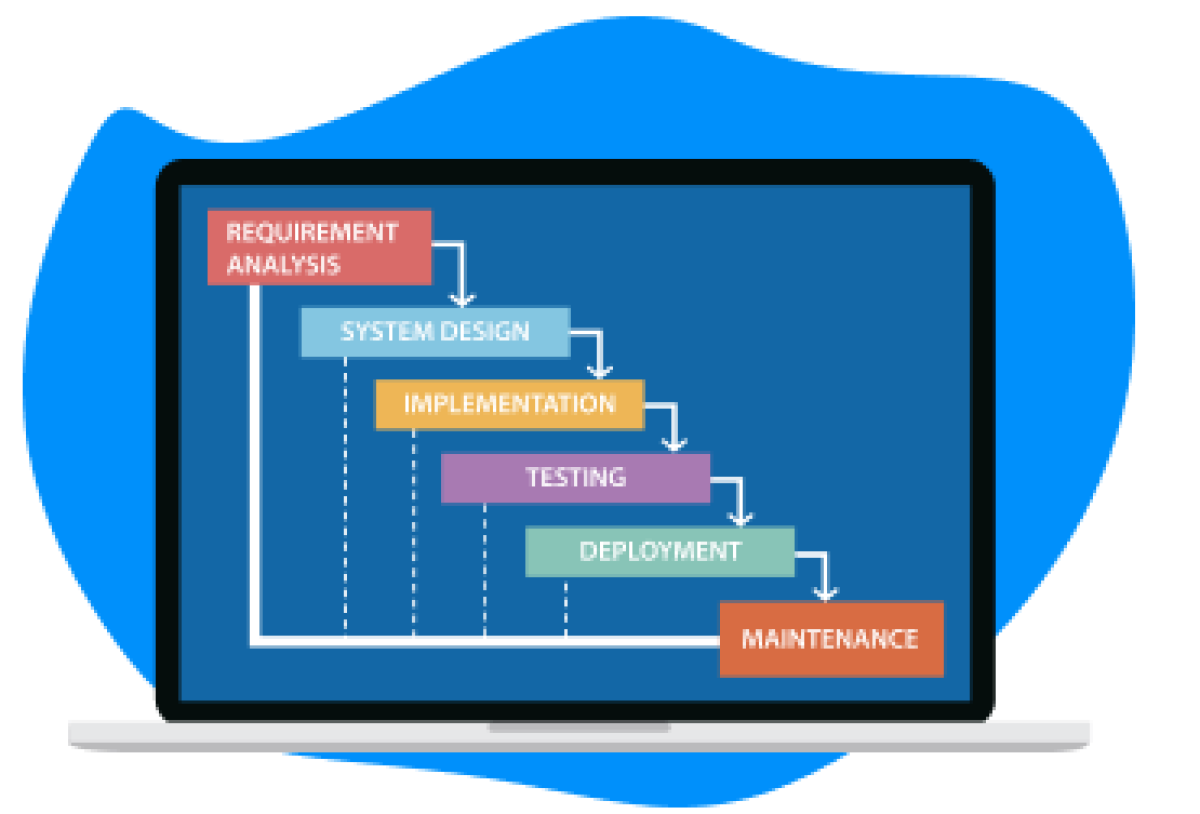
Waterfall Project Management is a sequential, linear process of Project Management. It consists of discrete phases. No phase begins until the preliminary phase is complete, and each phase’s completion is terminal — Waterfall Management does not permit you to return to a previous phase unless it is critically necessary, in which case you are forced to repeat subsequent steps.
Strict? Rigid? But that’s what it is. It primarily arose out of necessity in certain types of projects. In construction, can you construct the superstructure before the foundation? Or reconstruct the foundation after painting the walls? Can you perform consumer testing while launching an ad before the copy has been finalized? You may need to revisit the copy if consumer reaction is adverse, but that is another distinct phase in the project. Can you commence coding in a Software Project before the documentation is complete?
Planning is critical in the Waterfall system. The Project Plan contains the Project Charter, the Schedule Management Plan, the Cost Plan, the Quality Plan, the Scope Documentation, the Change Management Plan, the Stakeholder Requirements Plan, etc., and is initiated early in the project. They must be lucidly expressed, preferably including a flowchart. There is no scope for ambiguity in the Waterfall Process. Documentation is continuous because changes are permitted until a phase is complete.
Phases of Waterfall Project Management
The critical phases of the system are as follows:
Requirements:
- A Project Charter – a one-page document outlining the project’s broad objectives is defined at this phase, and approvals are obtained.
- Requirement gathering and documentation. All the stakeholders are requested to provide a detailed list of their requirements and expectations from the project during this phase. The methods may include interviews, structured questionnaires, brainstorming, or open-ended documents. By the end of this phase, the project requirements are usually precise, and then the Requirements document is circulated for approval.
- The Project Team is finalized.
- The Project Plan is documented as defined by its components above. Activities at the minutest level need to be defined along with timelines, costs, human resources, other resource requirements, etc.
Design:
System Design. It is typically done for software projects but may be relevant for other projects. The architect’s design is finalized during this phase of constructing a house. A software project clearly outlines the programming language, System Architecture, Database structures, tools, and hardware.
Implementation: The execution starts – with construction, ordering machinery (in a manufacturing project), coding in a software project, etc.
Verification:
This phase begins when the Quality Team reviews the product to ensure it meets the requirements at the beginning of the project. It is accomplished by testing the completed product thoroughly.
- Testing: When the work is completed, extensive testing starts. We have seen that a few vehicles are made to drive across a flyover to test their strength, test production is done in case of a new plant, and test marketing of a product is conducted among selective consumers. Integration testing of software at this stage will ensure that the system works from end to end.
- Modification of design: Bugs are corrected in software, the design of a product is altered if consumers have demanded the same, or the contents of an advertisement change based on consumer reactions. It is a distinct phase and will be followed by another round of testing.
- Delivery/deployment: The product, software, constructed house, bridge, or railway is now ready for live launch. Manuals are prepared, and training of the operators or other users who will be involved in running the system is completed.
- Closing of the phase/project: The most crucial step here is to obtain the approval of the stakeholders, who will certify the project as complete. Besides, contracts must be closed, contractors paid, and team members redeployed. Ideally, this should be done at the end of every phase.
Maintenance:
This is also considered a project phase for a short duration, so the project team is around to sort out teething problems and issues.
Benefits of Waterfall Project Management
- Since Waterfall Project Management requires extensive documentation, you should be okay with project team members leaving the organization. A new member can pick up the nuances of the project with little effort.
- There is clarity regarding the progress of the project. Since the project plan is clearly defined for every project and timelines computed for each irreducible Activity, one has to look at the plan to understand how the project is progressing and the days/months/years left for each phase.
- Since milestones and the criteria for approval are clearly defined, there is no scope for considering a phase as complete if specific steps are skipped. Moreover, subdividing a project into phases ensures that the top members of the Management carry no false impression that everything is hunky-dory till the end.
- Manageability of the project is more accessible because of more remarkable lucidity, which automatically follows from extensive documentation.
- It costs less. A systematic working method ensures that overtime, hiring more resources to crash delayed projects, reworks, etc., are avoided.
- Employee motivation. A systematic manner of working provides greater work satisfaction for team members.
The Projects Where Waterfall Methodology usually is not used
- An R & D project. It is because scientific experiments, by their very nature, are flexible. You may frequently be required to go back to the drawing board.
- Where projects must be completed within a crashed and definite timeline, parallelism must be employed, and piecemeal work must be done.
- If the project requirements initially lack clarity, are highly dynamic, or are likely to evolve with time. For example, they are constructing an edifice with uncertain soil conditions. Frequent changes in the business environment, like a competitor reducing his prices, may lead to changes in product design. Domains where technology changes are frequent also fall into this category.
Waterfall Versus Agile Method
- Unlike the Waterfall methodology, the Agile methodology assumes the need for constant revisits of earlier activities (there is no concept of phases here).
- The Agile method allows for much flexibility. Hence the quality could be better because of the constant involvement of the client and stakeholders instead of drawing them in at the Testing stage. Since testing occurs at the end, massive bug fixing may sometimes be required, following the Waterfall Methodology.
- The Agile method allows for concurrent working, as detailed above.
- Agile even allows changes in Project requirements, whereas Waterfall has no scope to change the requirements once the Project execution starts because it belongs to an earlier phase. Agile follows an incremental method suitable for projects where requirements can keep changing.
- Agile requires more experienced personnel than the Waterfall method because of its documentation’s inferior and less detailed quality. It requires a brilliant Project Manager, and new team members joining at an advanced project stage usually find it difficult to cope.
- The Waterfall is extremely useful for small, predictable projects with little uncertainty.
- The cost of implementing a Project following the Agile method is usually more than Waterfall because of frequent reversions to earlier phases. It should not be construed as a license to Project members and stakeholders to keep requesting changes. The PM needs to be very assertive in this aspect.
Conclusion
the Waterfall methodology in project management is a linear and sequential approach that has been widely used for many years. It is suitable for projects with clear requirements and a fixed scope, where all phases can be completed before moving on to the next. However, this approach may not be effective for complex or evolving projects, as it can be rigid and inflexible. Additionally, it can be difficult to make changes once a phase is completed, and it may not allow for feedback and adjustments during the development process. Therefore, it is important for project managers to carefully consider the suitability of the Waterfall methodology for their projects and be prepared to adapt and adopt other methodologies, such as Agile, when necessary.
