

2020 was the year when many new organizations experienced the advantages of SaaS business model. Be it cost savings, improved flexibility, scalability, and, more than anything else, convenience – it ticks all the right boxes. It was also a year that saw consumerization of SaaS. Working, learning, socializing, and shopping from home, end-consumers took to SaaS like never before.
Related read: SaaS in 2020: a look back at the year which accelerated its adoption
So, what’s 2021 going to be like? It sure is going to be an exciting year for SaaS – a tipping point in its history.

Table of Contents
How will demand for SaaS shape up in 2021?
The year will be marked by the accelerated adoption of SaaS. The IDC FutureScape 2021 report predicts that post-COVID, 80 percent of enterprises will double the pace of the shift to cloud-based applications and infrastructure.
According to a Gartner report, the growth rate for global revenue from SaaS will double from 16 percent to 32 percent year-on-year. The projected revenues for 2021 stand at $120billion. A third of this demand is likely to come from small and medium businesses, which will require a more customized experience.
Worldwide Public Cloud Service Revenue Forecast (Millions of U.S. Dollars)
| 2019 | 2020 | 2021 | 2022 | |
| Cloud Business Process Services (BPaaS) | 45,212 | 43,438 | 46,287 | 49,509 |
| Cloud Application Infrastructure Services (PaaS) | 37,512 | 43,498 | 57,337 | 72,022 |
| Cloud Application Services (SaaS) | 102,064 | 104,672 | 120,990 | 140,629 |
| Cloud Management and Security Services | 12,836 | 14,663 | 16,089 | 18,387 |
| Cloud System Infrastructure Services (IaaS) | 44,457 | 50,393 | 64,294 | 80,980 |
| Desktop as a Service (DaaS) | 616 | 1,203 | 1,951 | 2,535 |
| Total Market | 242,697 | 257,867 | 306,948 | 364,062 |
The changing nature of demand will reshape the fundamentals of the product:
1. Unbundling will be the new normal: More customers will demand customized experience as not all of them need all the features of a given application. Unbundling of packages by SaaS providers will help SMBs to pay only for functionalities they need.
2. Transition to PaaS: Driven by the need for personalization, customers may opt for PaaS products that allow them to build add-ons to the original product. It may emerge as a more flexible and scalable alternative to SaaS.
3. More automated API integrations: Most organizations today use multiple SaaS products, each with different strengths. Increased unbundling and transition will push the demand for automation that enables customers to perform easy integrations.
There’s no doubt that developers have their work cut out for them.
SaaS development trends that will dominate 2021
SaaS development in 2021 will witness the emergence of six trends:
1. Mobile-first approach
With mobile phones getting more powerful, SaaS applications today can be run on a handheld device.
Also, as mobile users outnumber PC users today, it’s only natural that SaaS apps will benefit by adopting a mobile-first approach. Doing so doesn’t just enhance its utility value but may also help it find more users. As a SaaS developer, even if you have reasons to believe otherwise, it is better to start exploring than to be caught unaware at a later stage.
2. Low or no-code SaaS platforms
Low-code or no-code involves developing new applications using toolkits, drag-and-drop interfaces, and so on. Enterprise businesses can build apps at scale and respond to changing user needs quickly by enabling a non-technical person to develop an application.
According to Forrester, more than 50 percent of developers are inclined to adopt one or the other low-code tooling.
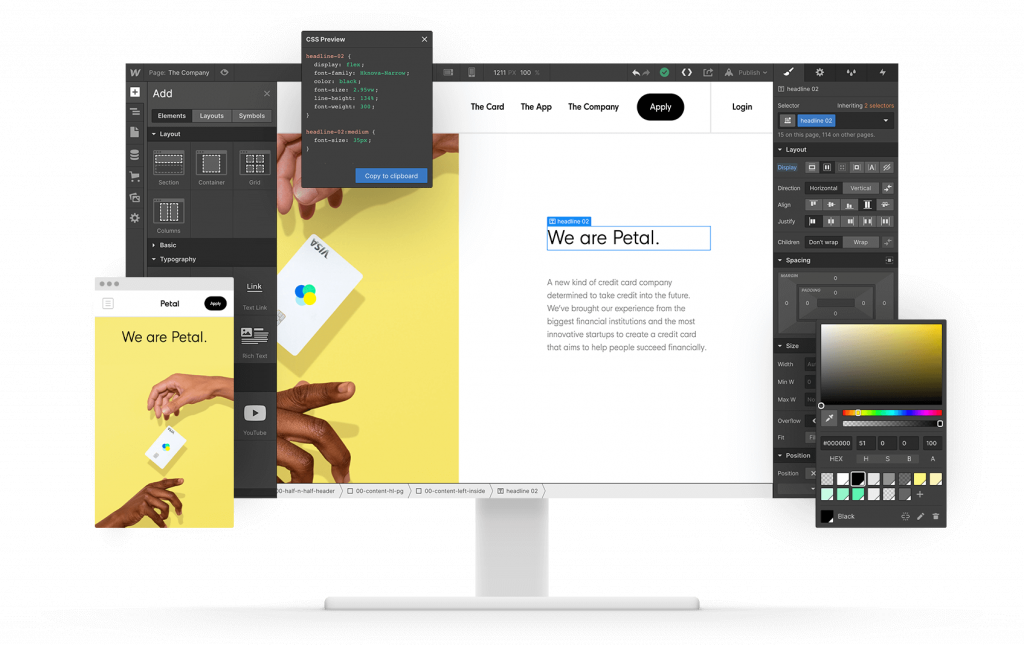
With companies like Bubble.io, Webflow, and Airtable attracting active VC interest in the past two years and COVID opening a whole new market, we can expect a slew of low/no-code platform launches in 2021. That, in turn, will also result in a slew of investments in the space. In case you missed the news, Airtable raised $185million at a $2.5billion valuation in the middle of the pandemic. Similarly, Unqork raised a $207million Series C investment at a valuation of $2billion.
Related read: SaaS companies that got the funding in 2020
3. AI in SaaS
COVID-19 was a lesson in dealing with uncertainty. Businesses had to rapidly learn and adapt to a new set of circumstances every few weeks. Analytics and AI proved to be an indispensable tool for making sense of data amid changing trends.
2021 will be the year when artificial intelligence will transform business intelligence tools. Most business executives will actively seek and rely on AI-powered real-time insights for decision making.
4. Vertical-specific SaaS
Industry or vertical-specific SaaS is another trend that is likely to become popular in 2021. Examples abound; the most recent one is Zenoti, a SaaS provider focused on the beauty and wellness industry. With $160million in funding, it became the fifth SaaS-based Indian unicorn.
5. Micro SaaS

Micro SaaS refers to add-ons to major SaaS platforms; think Grammarly to Chrome or Boomerang to Gmail. The growing popularity of Micro SaaS could either be a prelude to greater adoption of SaaS products or its consequence. In either way, 2021 will be a year of Micro SaaS too.
6. Emergence of white labels
What happens when an industry, as a whole, faces a sudden surge in demand? Existing players struggle to meet the demand; new players emerge. On the customer side, larger B2B customers prefer a known brand, whereas smaller ones prioritize cost. However, both would want a product that solves their problem.
Enter white label SaaS solutions.
White labeling allows for branding and selling of SaaS solutions developed by someone else for a fee. It cuts down the time to market by doing away with the need to re-develop an existing solution. Also, it allows the smaller SaaS companies to get some skin in the game quickly, without having to build a team and develop a product from scratch.
7. Blockchain in SaaS
Most people may be surprised to see Blockchain in SaaS as one of the possible trends. However, there’s a good reason we believe it to be the case. For starters, Blockchain technology has many applications beyond cryptocurrencies; cybersecurity is prime among them.
The number one security challenge associated with SaaS is the risk of tampering with centralized databases. Although on-premise software also carries the same risk, businesses are relatively less hesitant because of a perceived sense of control.
The decentralized databases of Blockchain can address the security challenge in SaaS effectively. As information is stored on multiple databases, hacking, editing, deleting, or executing any other unauthorized action becomes almost impossible. The authorized or legal edits operate on a mutual consensus of systems in a Blockchain. We’re already seeing the blockchain being implemented in e-signatures.
Challenges to SaaS in 2021
The accelerated adoption brings with it a rapid change in the landscape and an unprecedented set of challenges. Most of it will be under three fronts:
1. Security and compliance
With the whole world moving to the cloud, security is the obvious risk that follows. It will be compounded not just by the increased demand but also by new vendors in the markets. Additionally, compliance may also be compromised because of the urgency in the adoption by first-time customers.
2. White-labeling might affect innovation
Even though white labeling has its advantages, there is a good chance of the market being flooded by a single product, driven by sales prowess rather than quality. The cost advantages that white labeling offers may disincentivize innovation for a long time to come.
3. Complex pricing
Unbundling and white labeling together are set to disrupt the traditional fixed pricing methods based on the number of users or value. Value-based pricing on features could be a challenge because what’s valuable for one industry may not be for another. On the other hand, new players with white-labeled products may indulge in predatory pricing, making purchase decisions more difficult.

Then there’s the fact that many products have freemium model, which is good to get the initial user growth. But it also means that the company should have enough money in the bank to be able to afford to offer the same.
What does 2021 hold for SaaS? Disruption.
2021 will be a year of disruption of business, product, and pricing of SaaS. Demand and supply will undergo a series of rapid incremental shifts, requiring recalibration every now and then.
On the supply side, many new players will emerge banking on either innovation or white-labeled products. Most of this growth will come from new players in new geographies. Heard of SaaS startups in the Middle East and Africa? Yes, SaaS startups are already moving beyond the pockets of Silicon Valley.
On the demand side, SaaS will move up in the priority shopping list of many organizations placing a whole new set of demands. While some could be addressed by micro-SaaS products, others would require deep technical expertise. Thus, 2021 will witness the spawn of new vertical SaaS providers in hitherto unserved industries.
Overall, COVID could prove out to be the tipping point for SaaS, making it as ubiquitous as apps on a smartphone.
