


Cloud computing has emerged as a standard for both businesses and individuals. The management of cloud computing products and services is referred to as cloud management. There are software known as cloud management platforms that are designed especially to help you in managing your cloud environments.
But, with a plethora of these cloud management platforms present in the market, picking the one that best suits your organization can be quite challenging. That is why we at SaaSworthy have put together a list of the 5 top cloud management platforms that you can use in 2021.
Table of Contents
What is a cloud management platform?
Cloud management platform helps in managing public, private, and hybrid cloud environments with the goal of increasing agility and lowering costs. It serves businesses of all sizes. The platform provides access to vast amounts of memory, processing power, and storage to cater to the computational demands of an organization.
Cloud management tools enable the management of various platforms from a single reference point, as well as the use of intelligent analytics to automate processes. This includes application lifecycle management, the ability to manage system faults automatically through functionalities like self-monitoring, and an explicit alert mechanism.
The 5 top cloud management platforms to use in 2021
Go through the list of the top 5 cloud management platform examples in 2021 before choosing the one that best suits your needs.
1. OpenStack
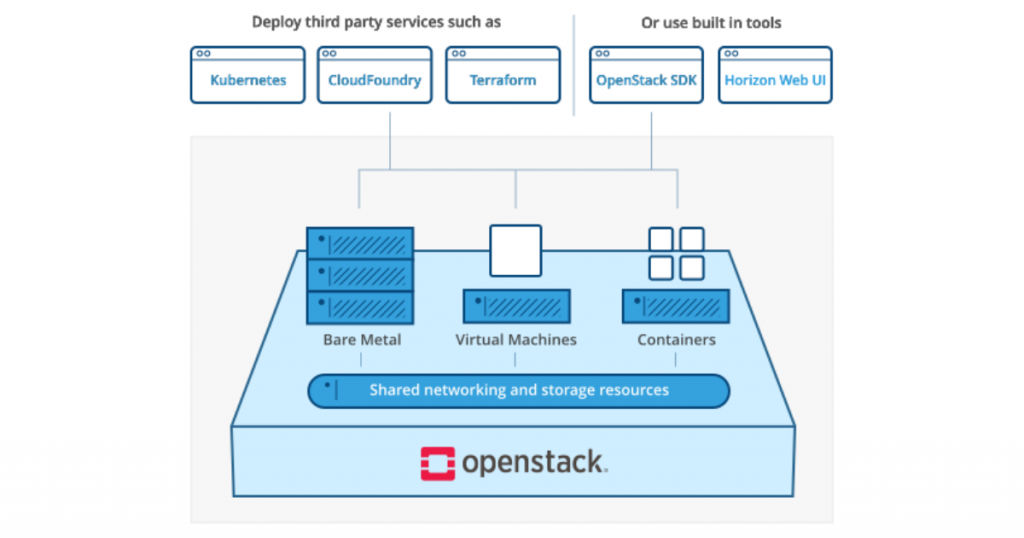
OpenStack is a free and open-source cloud management platform by Apache. It is most commonly used as an infrastructure as a service (IaaS). It is intended for the creation of both private and public clouds. Users can manage their cloud via a dashboard or via OpenStack’s API. OpenStack is SaaSworthy’s first choice if you are looking for a top cloud management platform.
The various features of OpenStack include –
- OpenStack works well in heterogeneous networks. All critical processes, including workload provisioning, application lifecycle management, networking, storage, and container infrastructure, are automated by the platform.
- You can manage and automate resource pools. It supports virtual systems, bare metal configurations, and containers. It works with old systems as well as third-party systems.
- Big data processing RCA, framework provisioning, container orchestration engine, support for multi-region deployments, and bare-metal provisioning are all features that add value.
- OpenStack Dashboard provides a graphical interface for administrators and users to access, allocate, and automate cloud-based resource deployment.
The limitations of OpenStack are –
- It has a complex architecture and a steep learning curve that can be challenging for beginners.
- It has occasional stability issues and can crash.
2. Apache CloudStack
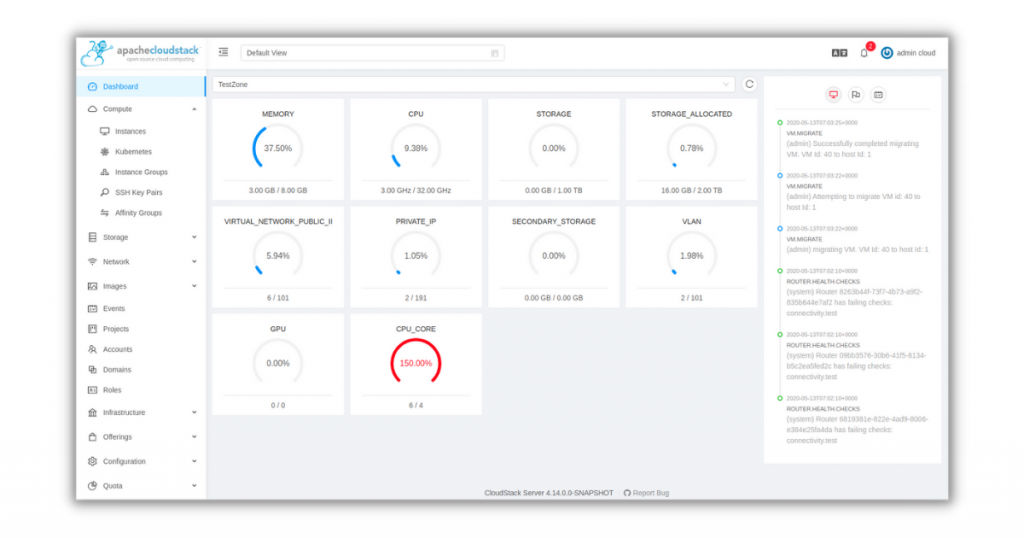
Apache CloudStack is a free, highly scalable, and open-source cloud management platform. CloudStack’s API works with AWS EC2 and S3. It is suitable for small, medium, and large-scale organizations that want to use hybrid clouds. It has six data centers in the USA, Asia, and the UK. Apache CloudStack is SaaSworthy’s top choice as one of the best multi-cloud management platforms.
The various features of Apache CloudStack include –
- Apache CloudStack features a RESTful API that allows you to integrate with a variety of third-party services as well as create and run your own applications.
- It provides network as a service (NaaS), resource auditing, compute orchestration, user and account management, and security features. It encompasses comprehensive service management, various types of storage, and provisioning of resources.
- It comes with a variety of tools for managing users, assigning management tasks, segregating cloud resources, etc.
- It can run any hypervisor and easily integrate with any virtual machine monitor you have in your system.
The limitations of Apache CloudStack are –
- Apache CloudStack is not as customizable as OpenStack.
- Listing resources can be slow at times as it is a complex platform.
3. BMC Cloud Lifecycle Management
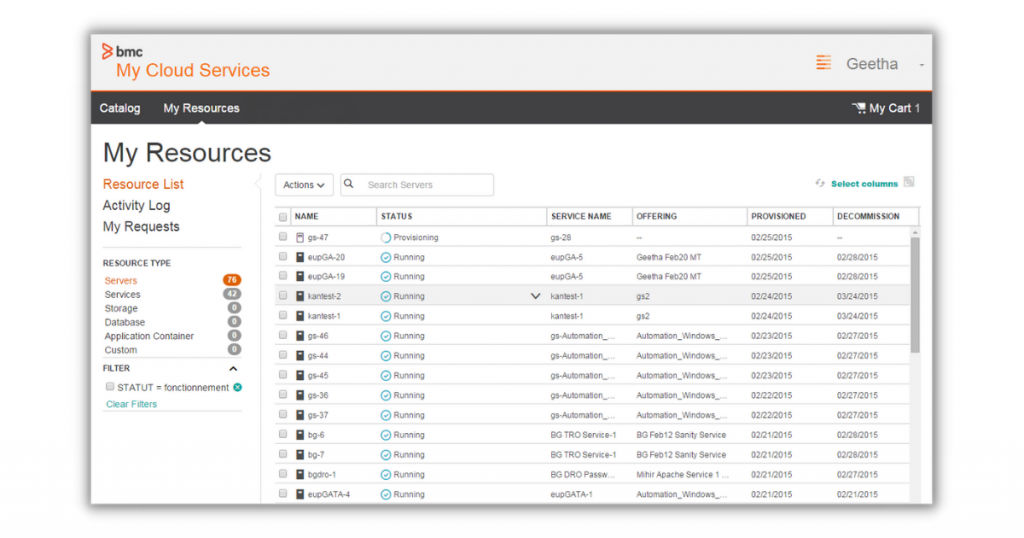
BMC Cloud Lifecycle Management is one of the best multi-cloud management platforms available in 2021. It provides users with the ability to manage multiple clouds in a variety of ways. It includes built-in integration with configuration management and change management database. It is a global leader in assisting traditional businesses in their transformation into digital enterprises.
The various features of BMC Cloud Lifecycle Management include –
- It intelligently places services across traditional infrastructure, private and public clouds, and avoids service API lock-in while maintaining choice across any platform.
- It allows users to deploy simple use cases quickly and scale up to production-grade hybrid cloud management.
- It remains neutral in service delivery throughout all platforms based on targeted workload requirements. This is compatible with a variety of infrastructures and public clouds, enabling users to retain flexibility while preventing vendor lock-in.
- Its advanced blueprint functionalities automate the ongoing management, provisioning, and de-provisioning of an entire business service, allowing users to benefit from full-stack service provisioning.
The limitations of BMC Cloud Lifecycle Management are –
- The technical support team that is provided is not performing up to the mark.
- It can experience the occasional bugs and glitches.
4. Scalr
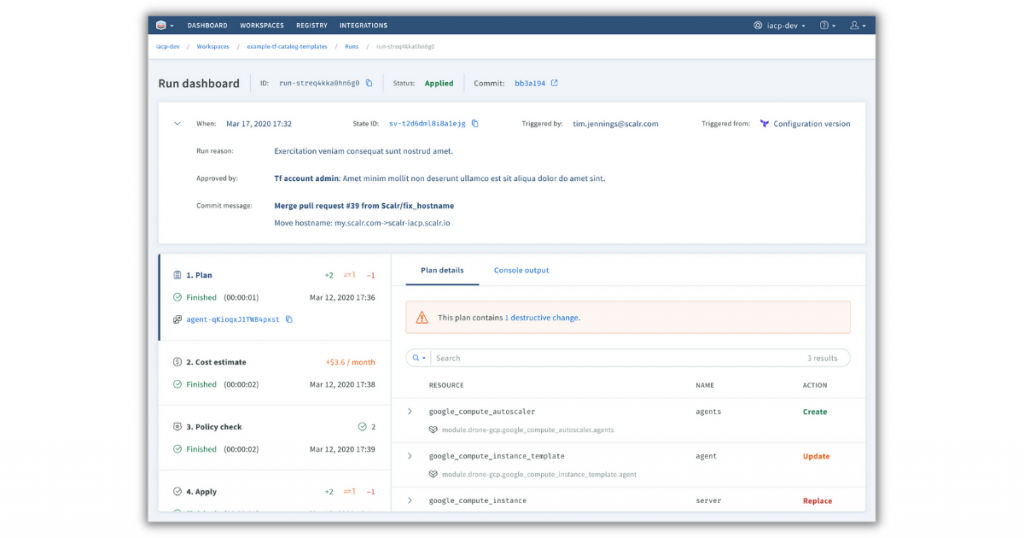
Scalr is a hybrid, top cloud management platform with a strong emphasis on automation and self-service. Scalr is also well-known for its ability to scale to thousands of users. Scalr is the best cloud management software for huge companies. The learning curve is short, thanks to its simplicity and excellent support. Its cloud strategy does not compromise safety, expenses, or efficiency.
The various features of Scalr include –
- It comes with self-provisioning from a predefined service catalog, as well as a policy engine to assert resource provisioning and usage controls.
- It recently introduced role-based access control (RBAC) security, which includes five built-in roles to give users and groups granular control over their permissions.
- It manages everything through a dashboard that simplifies the user experience by requiring only a single user interface and API to manage multiple cloud platforms.
- Its self-service cloud management enables modular infrastructure with flexibility while lowering costs. Its approach of automating and standardizing application deployments increases cost-effectiveness.
The limitations of Scalr are –
- It provides a limited number of customization options and lacks test automation.
- It has limited support for cloud services and does not support some PaaS out-of-the-box.
5. CloudBolt
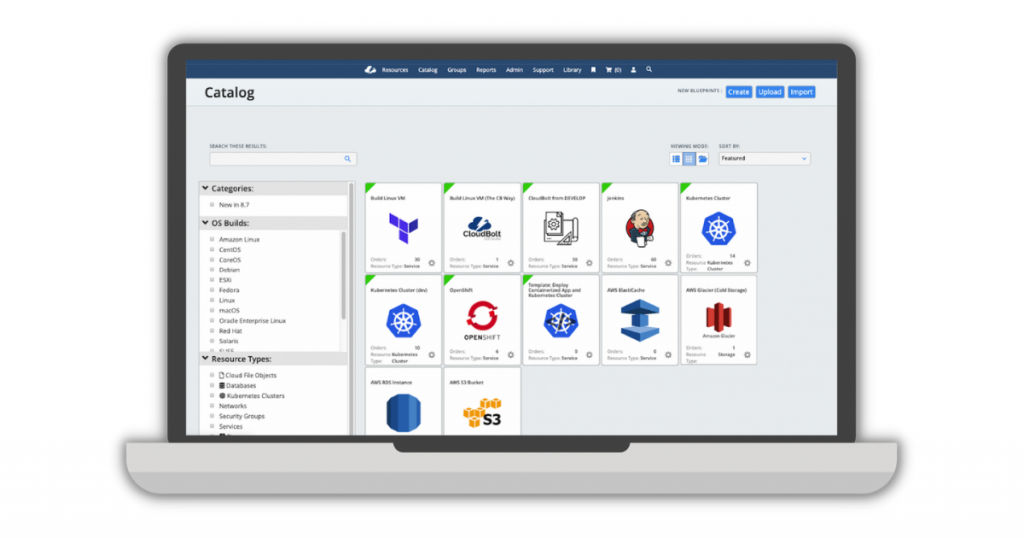
CloudBolt is a multi-cloud management platform that enables users to manage hybrid and multi-cloud environments via self-service IT. The software is easy to use, robust, and provides access to resources. It provides users with excellent dashboards that offer insights into multi-cloud infrastructure, allowing them to make educated decisions. CloudBolt enables users to quickly, cost-effectively, and securely unify their hybrid cloud resources.
The various features of CloudBolt include –
- It allows for the simple import, synchronization, and management of old deployments while also assisting the company in the development of new cloud environments.
- CloudBolt supports a wide range of cloud technologies, including on-premises virtualization and private cloud, public and hybrid cloud configurations.
- CloudBolt works with IPAM solutions, CMDB, configuration managers, and all other server management systems. This allows end-to-end builds to be completed in a single step and with a single Ul or API call.
- It operates using agentless technology, which simplifies the deployment of resource blueprints across various contrasting cloud environments.
The limitations of CloudBolt are –
- Customer support tends to take quite some time to respond to the user’s queries.
- Supports only a few integrations and out-of-the-box workflows.
Conclusion
It is obvious that cloud management platforms are important in this technology-driven era. You should implement a cloud management platform for your business as soon as possible. We hope that you were able to gain some knowledge regarding the various features and limitations of the 5 top cloud management platforms. You can now choose a cloud management platform that best fits your needs.
If you want to learn in-depth about cloud infrastructure, check out SaaSworthy’s article on cloud infrastructure.
Also read:
• 5 Top Hotel Point of Sale Systems: Features, Benefits, and Pricing
• 7 Tips to Help You Choose the Right Cloud Service Provider for Your Business
