

A leadership style helps your direction to lead a team. There are quite a few leadership styles, and two terms are most familiar with businesses: Transactional and Transformational leadership. Let us explain these terms, their dissimilarities, what markers are needed to be a transactional or transformational leader, and which leadership style you may like to adopt.
Table of Contents
Transactional vs. Transformational Leadership
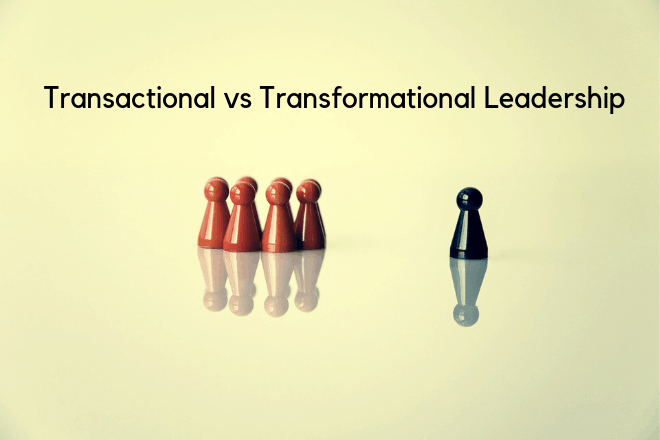
In management and motivation, Transformational and transactional leaderships are opposites. Transactional leaders focus on organization, management, and team performance, whereas transformational leaders focus on organizational change and progress.
Transactional Leadership
Transactional leadership styles manage the normal flow of operations – keep the ship floating. To motivate employees to perform their best, transactional leaders use authority and offer incentives to keep them motivated. The term “transactional” means that leaders encourage their staff by offering rewards for performance. Transactional leaders are generally not responsible for taking the organization to a position in market leadership; instead, they ensure it runs smoothly, and that work goes regularly. They are also responsible for discipline at the workplace and account for collective responsibility for the company’s growth.
Since we know leadership means managing people and influencing their behavior so that organizational goals can be achieved. To achieve these goals, leaders count on some leadership style that defines the expected result. These two styles are transactional and transformational leadership. The approaches are diametrically opposite; both have significant benefits for creating favorable change and growth. As a leader, you need to know the different styles and learn how to use or incorporate them in different situations. The transactional leadership approach is more organized and relies heavily on stringent checks and balances in the company.’s management. The technique follows the principles of support and exchange. It is all about managing employees by assigning precise tasks and rewarding their accomplishments. Employees also enjoy some autonomy within the company once they achieve their targets.
According to transactional leadership theory, a transactional leader brings followers together for a common purpose. It comprises give-and-take policy, penalty, reward, governance, and management. Employees learn to respect the hierarchy, which is essential.
Types of Transactional Leadership
There are three types of transactional leadership:
- The passive transactional kind of leadership is ‘control by expulsion’. In this technique, the leader fixes goals for the team and interferes when goals are not achieved or there is a problem.
- The active type of ‘managing by exception’. The leader monitors progress and adjusts with the team to achieve the target. It focuses more on interpersonal skills.
- The constructive type is when the leader states his expectations, praises the ongoing progress, and shares tips, leads, and feedback. This type of transaction is considered the most useful.
Effectiveness of Transactional Leadership
Transactional leadership suits when the team strictly adheres to tasks, procedures, work, projects, and policies laid out before them, and they carry out without any deviation. The advantages of transactional leadership are as follows:
- Attainable short-term goals, accomplished in a brief time frame, are easily achieved. The team remains motivated, and there are fewer chances of getting demoralized.
- A precise, brief structure lets employees know what to achieve and what the management expects.
- Performance Analysis and Cost Control measures should be conveyed to the employees, who become aware of short-term goals. The employees complete their targets following a strict plan.
Transactional Leadership Features
- Focus on short-term objectives.
- Favor structured policies and practices.
- Grow by following rules and doing things perfectly.
- Value efficiency.
- Very logical.
- Tend to be unbending.
- Averse to change.
Benefits of Transactional Leadership
- Effective in responsively sustaining the Status Quo.
- Extremely practical in crisis control and troubleshooting.
- One-person leadership follows a single line of command which is cost-effective.
Weaknesses of Transactional Leadership
- Not Flexible and averse to changes from the laid down procedures even when there is a chance of success following a different strategy.
- This model inspires the followers only on the grass-root level.
Transactional Leaders
- While leaders like Steve Jobs did not have a complete transactional approach, Jobs led with an iron fist and delivered substantial results. His control is evident in Apple products.
- Bill Belichick, the NFL coach, formed his style in Sun Tzu’s “The Art of War.” His rigid top-down practice brought many trophies to Lombardi.
Transformational Leadership
Transformational leaders do not generally manage everyday operations but make strategies for taking their business, unit, or team to the next level of achievement and success. Transformational leadership styles stay focused on team-building, motivation, and teamwork with employees at different levels of an organization to improve.
These leaders specify objectives and offer perks to motivate their teams to climb higher performance levels. They also offer the employees opportunities for personal and professional growth.
This leadership style includes developing employees’ talents rather than making them achieve production or sales purposes. Transformational leaders focus on personal and professional growth and encourage all employees to pursue creative pursuits while looking for solutions to existing problems.
Teams need an inspiring leader who challenges the prevalent order by being open to prospects, accepting ideas, and changing them for the company’s benefit.
Four “I’s” of Transformational Leadership
The four “I’s”/the four components of the transformational leadership style include:
- Intellectual Stimulus: Facilitating new ideas and ways of thinking for the team and yourself that leads to the company’s organic growth.
- Individual Consideration: Mentoring workers, helping their professional maturation, and leading them to success.
- Inspirational Motivation: Making the company’s vision clear to the employees so that they learn and work independently to achieve the goal.
- Idealized Influence: Becoming an ideal leader deriving high-performing team behavior and nurturing the team while keeping them motivated.
There is a lesser chance of micromanaging; transformational leaders try and provide an independent workspace that fosters originality and innovation. Employees get the freedom to make their own decisions.
Effectiveness of Transformational Leadership
Although transformational leadership is preferred, it works better when a product or service is newly launched or in an enterprise where innovation is the key. Such leadership is suitable for a start-up where rules and methodologies need to be set, and ingenious thinking and policy-making can be necessary.
Transformational leaders can lead with their futuristic vision, support, and moral boosting to keep the team motivated and focused and maintain a much higher energy level. Nokia‘s growth story from a timber merchandiser to a world leader in mobile communications has become a quotable quote.
Transformational Leadership Features
- Foresightedness in leadership
- Believing in hearts and minds
- Motivating and inspiring
- Achieving long-term goals
- Contributing to society and culture with the ideas
- Deciding the best for the company
- Unique, uplifting leadership style
Transformational Leaders
Some examples of transformational leaders include:
- Through transformational leadership, Bill Gates reached heights following structure, organization, and consistency. He inspires his teams by stimulating them intellectually. In the growing-up years of Microsoft, Bill Gates used a domineering leadership style to help the company grow at the pace he had anticipated.
- Elon Musk’s success depends on his incredible approach to leadership. He took the challenges head-on and took failures as his pillars of success, and these became his strategies.
Transactional versus Transformational Leadership: Which One to Choose?
We have already seen that both approaches are promising, and despite apparent contrasts, they are not mutually exclusive. These styles ensure leadership effectiveness and should be well structured to achieve the desired results.
Similarities between Transactional and Transformational Leadership
Transactional and transformational leadership are similar in that they tell us how to handle teams and use different tools to keep them motivated and get the best out of them.
Both approaches are compelling and concern team leaders and followers with the single goal of organizational benefits and individual growth.
Dissimilarities between Transformational and Transactional Leadership
The significant differences between transformational and transactional leadership are motivation, rewards, and punishment—both the styles in terms of dividends follow different approaches, and they are:
- Low-level Exchanges happen in transactional leadership. These are simple daily exchanges that are easy to record. Keeping records of salaries, holidays, work hours, benefits, etc., form low-level interactions between leaders and their teams.
- High-level exchanges occur between two parties, and interaction happens on a high level. These interactions are complex and built on conviction, personal commitment, dedication, approval, security, acceptance, and collective performance.
- Instant solutions to problems happen in transactional leadership, whereas in transformational leadership, issues are solved before they become critical.
- The organizational culture is followed by transactional leaders who do not try to bring changes, while transformational leaders encourage new ideas and are ready to inculcate uniqueness in the corporate culture.
- Rewards and punishment are accorded as per the organizational standards by transactional leaders. Transformational leaders promote investment in projects, and employees can become stakeholders, leading to a unique internal reward system.
- Charisma and influence are used in transformational leadership, whereas the transactional leadership style suits leaders with less authority and more personnel management.
Conclusion
Balance transformational and transactional leadership is the most practical way. A proactive, transformational leader should be at the helm of organizational affairs, and some mid-level managers can use a transactional style.
It should only occasionally be the default option for every team or project. In both approaches, run-of-the-mill ideas need to be discarded. To run an organization effectively, we need to employ both approaches.
