

The increase in the usage of Vertical SaaS has become a defining trend in the software industry, particularly as businesses increasingly seek tailored solutions that address specific industry needs.
This article explores the statistics for Vertical SaaS in 2024, highlights top examples of companies leading the charge, and discusses their impact on the broader SaaS ecosystem to set the foundation for 2025.
Table of Contents
What is Vertical SaaS?
Vertical SaaS refers to software solutions designed specifically for a particular industry or market segment. Unlike horizontal SaaS, which offers generalized applications suitable for various sectors, Vertical SaaS provides specialized functionalities that cater to unique industry demands. This approach allows companies to achieve higher customer satisfaction and loyalty by addressing specific pain points within their operational workflows.
Key Statistics for Vertical SaaS in 2024
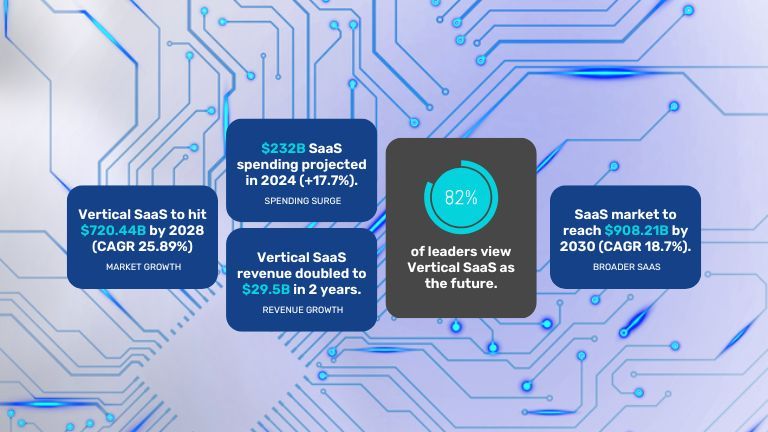
The growth of Vertical SaaS is underscored by several compelling statistics:
- Market Growth: The global Vertical SaaS market is projected to reach $720.44 billion by 2028, with a compound annual growth rate (CAGR) of 25.89% from 2021 to 2028 (Source). This rapid expansion reflects the increasing demand for specialized software solutions.
- Overall SaaS Market Growth: The broader SaaS market is expected to reach $908.21 billion by 2030, growing at a CAGR of 18.7%(Source). Within this context, Vertical SaaS is gaining significant traction.
- Expenditure Increase: Gartner predicts that SaaS expenditure will increase by 17.7%, totalling approximately $232 billion in 2024(Source). This growth highlights the increasing reliance on cloud-based solutions across industries.
- Customer Preferences: A survey found that 89% of executives and IT leaders agree that Vertical SaaS is the future of software solutions, indicating a strong preference for specialized applications over-generalized ones(Source).
- Revenue Doubling: Companies listed in the Vertical SaaS Index have seen their total last twelve months (LTM) revenue double from $14.9 billion to $29.5 billion over the past two years, showcasing robust growth in this sector (Source).
Also read: 15 Customer Acquisition and Retention Strategies for SaaS Companies
Top Examples of Vertical SaaS Companies
Several companies exemplify the success and impact of Vertical SaaS across different industries:
1. Veeva Systems
Veeva Systems specializes in cloud-based software solutions for the life sciences industry. Its products streamline processes related to clinical trials, regulatory compliance, and customer relationship management (CRM). Veeva has established itself as a leader in this niche, with an impressive revenue exceeding $2 billion annually.
2. Procore Technologies
Procore provides construction management software that enhances project collaboration and efficiency. The platform integrates project management tools, budgeting, and scheduling features tailored specifically for construction professionals. Procore has seen substantial growth, with revenues surpassing $500 million as it continues to expand its market share.
3. Toast
Toast is a restaurant management platform that offers point-of-sale (POS) systems integrated with various operational tools such as payroll and inventory management. With an ARR of approximately $260 million, Toast has revolutionized how restaurants operate by providing comprehensive solutions tailored to their unique needs.
4. Clio
Clio serves the legal sector with its cloud-based practice management software designed specifically for law firms. It streamlines case management, billing processes, and client communication, helping legal professionals enhance their service delivery while generating revenues exceeding $100 million annually.
5. Mindbody
Mindbody is a wellness business management platform catering to fitness studios and spas. It provides scheduling, marketing, and payment processing tools tailored to the wellness industry’s needs. Mindbody has successfully carved out a niche in this market, boasting revenues of around $100 million.
Impact on the SaaS Ecosystem
The rise of Vertical SaaS has profound implications for the overall SaaS ecosystem:
Enhanced Customer Relationships
Vertical SaaS providers develop deeper relationships with their clients by understanding industry-specific challenges and needs. This expertise enables them to offer superior customer service and tailored solutions that resonate more effectively with their user base. As a result, customer loyalty tends to be higher in vertical markets.
Competitive Advantage through Specialization
By focusing on niche markets, Vertical SaaS companies can differentiate themselves from horizontal providers. This specialization allows them to command premium pricing for their tailored solutions while also achieving better customer retention rates due to their unique value propositions.
Increased Adoption of Advanced Technologies
Vertical SaaS platforms are increasingly integrating advanced technologies such as artificial intelligence (AI) and machine learning (ML). These technologies enhance operational efficiencies by automating routine tasks and providing insightful analytics tailored to specific industry needs. As industries evolve, the demand for such sophisticated solutions is expected to rise.
Lower Competition Barriers
Vertical SaaS companies often face less competition than horizontal providers due to their focus on niche markets. This reduced competition allows startups to enter the market more easily and establish themselves as leaders within specific sectors. The lower barrier to entry fosters innovation and encourages new players to develop specialized solutions.
Data Governance and Compliance
Vertical SaaS solutions are well-positioned to address data governance requirements specific to industries like healthcare and finance, which have stringent compliance needs. By incorporating industry-specific compliance capabilities into their platforms, these companies enhance transparency and trust among users.
Emerging Trends Influencing Vertical SaaS in 2024
As we look towards 2024, several trends are shaping the future of Vertical SaaS:
AI Integration
The integration of AI into Vertical SaaS platforms is becoming increasingly prevalent. Companies are leveraging AI capabilities to automate tasks, derive insights from data, and improve decision-making processes. This trend not only enhances efficiency but also allows businesses to stay competitive in rapidly changing markets.
Value-Based Pricing Models
As the market matures, there is a shift towards value-based pricing strategies that reflect the unique value provided by specific features tailored to different industries. This approach enables companies to align pricing with customer outcomes rather than adopting one-size-fits-all models.
Increased Investment Activity
With growing interest in specialized software solutions, investment in Vertical SaaS companies is expected to rise significantly in 2024. Investors recognize the potential for high returns in niche markets where tailored solutions can command premium pricing.
Key Summary
Vertical SaaS represents a transformative shift within the broader software landscape, driven by an increasing demand for specialized solutions across various industries. With robust growth statistics projected for 2024 and beyond, along with innovative examples leading the charge, it is clear that Vertical SaaS will continue reshaping how businesses operate. As technology evolves and industries become more complex, the need for tailored software solutions will only intensify, solidifying Vertical SaaS’s role as a cornerstone of modern business operations.
FAQs
1. What are the key growth statistics for Vertical SaaS in 2024?
The global Vertical SaaS market is projected to reach $720.44 billion by 2028, growing at a compound annual growth rate (CAGR) of 25.89% from 2021 to 2028. In 2024, SaaS expenditure is expected to rise by 17.7%, totalling $232 billion, with a significant portion attributed to Vertical SaaS adoption across various industries.
2. Which industries are seeing the most growth in Vertical SaaS adoption?
Industries such as life sciences, construction, legal, restaurant management, and wellness are leading the charge in adopting Vertical SaaS. Companies like Veeva Systems (life sciences), Procore Technologies (construction), and Toast (restaurants) exemplify the rapid growth and impact of vertical solutions tailored to these industries.
3. What impact does Vertical SaaS have on the broader SaaS ecosystem?
Vertical SaaS is enhancing customer relationships by offering industry-specific solutions that meet unique needs. It is also creating a competitive advantage for specialized providers, lowering competition barriers, integrating advanced technologies like AI, and improving data governance and compliance, particularly in regulated industries such as healthcare and finance.
4. What trends are shaping the future of Vertical SaaS?
Key trends include the increasing integration of AI to automate tasks and improve decision-making, the shift toward value-based pricing models tailored to specific industries, and a rise in investment activity, as more investors recognize the potential of niche markets and specialized software solutions. These trends indicate that Vertical SaaS will continue to reshape business operations across various sectors in the coming years.
